To Top
This week saw the publication of my latest piece for the San Francisco Public Press, featuring an interview with a survivor of domestic violence. Read it online here. Print copies are available around the city, or email me if you want to order a copy for a few $.
On Friday, Erin Polgreen, Susie Cagle, Wendy Macnaughton and talked about graphic journalism at the Online News Association conference – there’s quotes and related media from it here on the ONA site
Last but not least, if you haven’t done already then order your print copy of the Education Reform Comic Adam Bessie and I put together for Truthout – using the widget below in the right hand sidebar. Only a few days left to get your copies! Just click on the “Chipin!” button and it’ll take you directly to paypal. Or email me if you’re allergic to Paypal. Thanks for your support!
If you’re a regular visitor to Archcomix, a graphic journalist enthusiast or just a first-timer here, then please consider contributing to the print run for my latest comic, The Disaster Capitalism Curriculum: The High Price of Education Reform, a comics primer to the US Education Reform debate. If you want to know the backstory to this week’s teacher’s strike in Chicago, or the origins of the reforms and their divisive effect on the political landscape – not to mention the view from the ground (or classroom) from several teachers and staff working in education, then look no further. $8 plus shipping through paypal. Use the link below or the widget on the right-hand toolbar. Thanks for your support!
Above is a wee taste of my latest collaboration to be published by Harper Collins: Man Vs Markets, by Paddy Hirsch. Its honourable goal is to explain the ins and outs of the financial system that we’re so used to seeing splashed over the front pages. I did the explainer doodles and cover art. Look inside the book here or order your very own copy here.
The latest Archcomix Newsletters is teetering towards completion, so expect that in your inboxes first thing next week. Not signed up? Click here to never miss another monthly missive again.
This month sees me, Susie Cagle, Erin Polgreen and Wendy MacNaughton discussing comics journalism at the Online News Association Annual Conference in San Francisco on Friday the 21st. More on the dramatically named panel (“Blow Up the Funny Pages”) here.
At last! The whole education reform comic Adam Bessie and I did for Truthout has finally aired. Check out part 1, part 2 and now, part 3. If you’ve enjoyed them then: share/tweet/do all the social stuff AND chipin in via the widget below to help get us a print run off the ground.
In case you missed it, part two of my comic on education reform went line on Truthout on Friday. Check out the first episode here and click here for the latest instalment.
Like a latter day Jimi Hendrix (swapping a laptop for a left-handed guitar), I had a great being part of the panel and keynote events over the weekend at the Woodstock Digital Media Festival. Saturday morning’s panel, Telling [TRUE] Stories, saw myself and Annie Correal, Community Manager at Cowbird, talk about our work and the different perspectives of single author/crowdsourced authoring online frameworks, moderated by Emily Bell, Director of the Tow Center for Digital Journalism at Columbia. The conversation really got going after our mini presentations, and the audience asked some great questions about monetizing (of course), audience demographics and the software behind it all.
During the afternoon I had the chance to talk to some of the other participants and discuss the pros/cons of mobile location apps, apple’s penchant for deliberate obsolescence and the future of long form storytelling, all against the verdant background of Vermont’s premier picture-perfect little sleepy town. Then that evening myself and three others (the digital media curator at NYC’s MoMA, the founder of Artfagcity art blog, and a technophile champion of the local fisheries) had the opportunity to wax lyrical about our respective fields for 20 mins before fielding questions over booze at Billings Farm afterwards. A wonderful chance to chat with like-minded new media folk and swap anecdotes about working with GIFs, the future of visual storytelling, and why latin america just cannot make it into the news these days (bar Mexico’s cartel war).
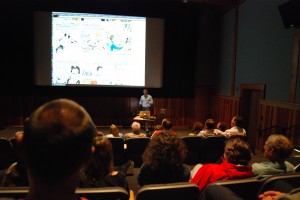
image courtesy of sukdith punjasthitkul
Here’s a preview from my latest comic on trafficking in the South Bay, out now in the latest edition of the San Francisco Public Press. I’ll post a link when it’s up online. Read their excellent coverage of bay area human trafficking here. In the meantime, ink and colour is being slung on the second part of the Education Reform Comic for Truthout. Here’s the first part in case you missed it.
This weekend I’m back in Vermont for the Woodstock Digital Media Festival, where I’ll be part of the “Telling [TRUE] Stories” panel tomorrow at 11:45. For a full list of my fellow new mediaphile participants, go here.
Last week saw the launch of the 4th incarnation of the Stanford Graphic Novel Project, which I’ve had the fantastic opportunity to work on for 3 years. The latest book, From Busan to San Francisco, is based on the true story of a young south korean girl who is trafficked to Los Angeles before ending up in an asian massage parlour in San Francisco. It’s a testament to the determination, hard work and enthusiasm of the talented students we had on board that the final product looks so professional! (Even if I do say so myself). All this in just two semesters! Ok, so 2.5 really – and a ton of elbow grease/hours staring into an assortment of Macs around campus. The usual graphic novel glamour. If you’re an educator, publisher or book critic then drop me a line for a review copy.
From Busan to San Francisco from Dan Archer on Vimeo.
You at the back! Close that book and pay attention. My latest comic on education reform in the US and beyond is out now: click here to read it.
A sneak preview from my latest comic on education reform, out next week on Truthout.org featuring Milton Friedman. I’m currently in Moscow at an independent media conference run by the Eurasia foundation – follow my live tweets/sketches below or directly on twitter.