To Top
Political pundits across the US and Colombia are on the edge of their seats debating the best course of action for the stalled, soon-to-be-scrapped year-old US/Colombia Military treaty. The treaty, which would allow for US use of 7 Colombian bases, was declared unconstitutional by the Colombian Constitutional Congress last week, and ruled it must be passed approved by the Colombian Congress. Now it looks like Santos, the new Colombian President, might be leaning towards scrapping the arrangement in order to appease his uneasy new neighbour Hugo Chavez. Read today’s op-ed on the saga over at the Washington Post. Find out more about the day of action against US militarism planned for Oct 11.
Turns out Colombia is quite the hotspot for US military action of late (not least Plan Colombia, starting in 1999) with a recent $42m civil settlement against everyone’s favourite military contractor, Blackwater (sorry, Xe services) from the State Dept, who apparently had no idea the company was providing combat training to groups in Colombia:
What is known is that the 2005 training was related to an agreement between Blackwater and the agency in Colombia, where “foreign persons were trained and deployed as third-country nationals in support of a contract with the US Department of State.” Blackwater responded to the State Department by stating that the training was held without the agency’s permission due to a “general misunderstanding” over licensing, although the department notes that there were many violations committed while Blackwater was “servicing US Government programs or providing training to US allies.”
What’s a little misunderstood paramilitary training between friends? More importantly, who knows how many of these “general misunderstandings” have led to the training of paramilitary groups in the region, trained under the guise of US foreign policy, that are impossible to hold accountable for their actions? Narco News has the full story here. And I may be a little late to the party on this one, but news is out that Blackwater is actually up for sale – though you can bet its Director Erik Prince will be keen to rebrand his paramilitaries-on-demand offering in the United Arab Emirates, where apparently he has skipped the country to in the wake of further scandals and mounting legal cases against his company. Serendipitously enough for Prince, the UAE doesn’t have an extradition treaty with the US either.
[Reminder: check out the Knight Project page for the first report on my latest animation project.]

EA games made the headlines last week with the announcement that the latest version of its Medal of Honor series would allow gamers to play as the Taliban and, of course, kill American soldiers. Click here to watch the Linkin Park-backed trailer in all of its bodycounting glory.
This comes fresh on the back of the announcement that Activision’s Modern Warfare 2 is officially the best-selling game of all time in the UK. Fox News jumped feet first into the melee, bringing a grieving Gold Star Mother into the studio to comment (watch the video here), but enough people have commented on the polemic for me not to go into a equally predictable defense of art imitating life. Instead, what I want to focus on here is the rise of the videogame as an increasingly sophisticated (not to mention supremely lucrative) art form. And most importantly, ask why we aren’t waking up to the potential that video games like Modern Warfare or Medal of Honor represent for news reporting? Scrolling through the comment thread at Gamrfeed’s original article on the issue, Puffy’s comment says it all:
I really don’t understand the argument here.. I mean this is a purely fictional piece of entertainment that is based on real events. Do these media types this that when people play these games in multiplyer [sic] they think, oh good, I wanna be the Taliban and kill some Americans? It’s just a name and outfit to distinguish your teammates from the enemy team, gamers don’t give a shit who they’re playing as in these titles.
What we need to do is redress the balance of this sort of technology being used for pure entertainment purposes and think about how an interactive, immersive digital environment would be the ideal way to introduce students/viewers to the reality of what life is like on the ground in Afghanistan/Iraq/ war zones. Patrick Farley’s doing a similar, albeit deliberately hyper-fictionalised and stylised version of Afghanistan (using 3D rendering tools) over at electricsheepcomix, which I highly recommend. Gamrfeed later ran an excellent piece featuring interviews with US military personnel on the issue, which you can read here. Just as we’ve seen with comics, too many of the supposed gatekeepers of culture see videogames as just another form of lowbrow entertainment and not a state of the art opportunity to engage with an audience on a totally new level. To that end, what do you think is the average age of a videogamer? Answers in the comments section…
At the Disabled American Veterans convention in Atlanta earlier this month, President Obama announced:
“As a candidate for president, I pledged to bring the war in Iraq to a responsible end. Shortly after taking office, I announced our new strategy for Iraq and for a transition to full Iraqi responsibility. I made it clear that by August 31, America’s combat mission in Iraq would end. And that is exactly what we are doing – as promised and on schedule”
However, the definition of troop withdrawal gets a little murky when you consider how many US personnel will remain in Iraq after the last “military” units leave. Here are 5 Iraq troop withdrawal myths from the Washington Post that get to the nub of the issue. For more information about the nature of the troops who will remain in Iraq, watch this video interview [from 2:34mins in] with Jeremy Scahill, who has been investigating the US’s increasing reliance on Private Armies (such as Xe Services, the rechristened company once known as Blackwater) in Iraq, Afghanistan and beyond. I’m currently reading his excellent book, Blackwater: The Rise of the World’s Most Powerful Mercenary Army , so will post my review once I’ve finished it.
For the scoop on last night’s talk at IDEO Palo Alto, go to my Knight Project page.
This brings my wordless comic on the economic meltdown to a close, but feel free to click here to read it from the start, tier by tier.
News below the fold, so scroll down. Today’s bulletins: the Iraq withdrawal and a report back on a talk at IDEO Palo Alto on the future of news and storytelling, given by Neal Baer, executive producer of ER and Law and Order, Special Victims Unit.
Please support my human trafficking comic on the crowdsourcing site Kickstarter.com if you haven’t already! Here’s the link to the pledge page, currently at 21% of our goal. Also checkout my new sketchbook uploads to Flickr (right hand sidebar).
News, as ever, below the fold, so scroll down. Please support my human trafficking comic on Kickstarter if you haven’t! Link is below on the right, currently at 21% of our goal.
Cartoonists Matt Bors and Ted Rall are traveling through Afghanistan as I tap, chronicling what life is like on the ground without the constraint of a military embed or government spokesperson in tow. Check out Rall’s blog here and Matt’s here.
Further to my post of August 9th, the Colombian Constitutional Court ruled yesterday that the proposed plan to extend US military operations throughout Colombia by sharing the Colombian military infrastructure was indeed illegal. Ex-President Alvaro Ulribe attempted to push it through without bothering to run it by lawyers, claiming it was just an extension of previous accords, but the court disagreed by 6 votes to 3. While that jettisons the 2009 accord’s plans, it doesn’t affect previous accords for now – until new President Santos takes the accords to Congress.
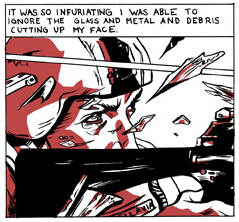
Panel from "The Insurgent" by Isaac Goodhart
I stumbled across this gem of an online comics anthology (for sample, see left) put together by students from NYC’s School of Visual Arts under the watchful eye of Nick Bertozzi. The link is to the Act-i-vate website (a great website for free top-notch webcomics) and shows the end result of a project to visually adapt US troops’ combat testimonies during their recent tours in Iraq.
We’ve also published an extract of the first story from Borderland over at borderlandcomics.com, which I’ve added to the ‘Trafficking” page. Other updates include the Honduran Coup: A Graphic History video on the “Honduras” page, so please watch, pass on and leave your comments.
I’m also delighted to announce that I’ll have a comic published in the seminal activist art anthology, World War 3 Illustrated, which should be out later on in the year. It’ll be an extract from an oldie from the 2007 archive chronicling the scandal around Burger King’s exploitation of undocumented central American migrant workers in Florida’s tomato fields. You can read it over at the US Politics page, now with a handy drop-down menu.
New here? Go to the start of the wordless comic above here. You can order a copy of my latest comic on human trafficking here – now at 19% of our total goal, so dig deep in those pockets and help us raise awareness of the plight of human trafficking victims. Thanks to those who already have.
Scroll down for news and updates below the fold.
More wordless panels for you, plus a shout to MTV Exit for sticking a link to our Borderland Comics site on their Facebook page. Also, be sure to check out daily developments on my upcoming Knight Journalism Fellowship via the Knight Project tab above. Plus you can now access individual comics via a handy drop-down menu by hovering over the said tabs – checkout the US Foreign Policy one to see what I’m talking about. Eagle-eyed Archcomix visitors will notice the new newsletter field on the left – add your email address and stay abreast of all future Archcomix rumblings. Big thanks to the tireless work of Stanford CS Senior Alex Easton for his help in making the said changes.
New here? Go to the start of the wordless comic above here. You can order a copy of my latest comic on human trafficking here – now at 18% of our total goal, so dig deep in those pockets and help us raise awareness of the plight of human trafficking victims. Thanks to those who already have.
As the Borderland comics kickstarter fund (see right) chugs along, we’re getting contacted by NGOs around the world who want to share and coordinate efforts to combat human trafficking. One of these was Oasis Global, who are behind the Stop the Traffik campaign. Click here to watch their intro video and learn how human trafficking might even affect how your favourite chocolate bar was made – apparently almost half the world’s chocolate is grown in Cote D’Ivoire. In the words of Steve Chalke, Stop the Traffik’s Founder and UN Special Advisor for Community Action against Human Trafficking:
“When Cadbury’s and Hershey and Mars and Lindt and Nestle and all of the others produce chocolate that is traffic-free, you can be sure that they will be the first to put a little mark on those bars telling us that. If a chocolate bar doesn’t say it’s traffic-free, it’s just not – it’s as simple as that”
In other news, the sketchbook studies on my Flickr page continue, this time with a Hardhats focus as I gear up for some enormous crowd scenes in Part 2 of my upcoming graphic novel, Hardhats. More on the Hardhats page here.