To Top

Photo: @Jasoncuddy via Flickr
This weekend saw one of the biggest protests sweep through London since the Iraq war march of 2003. Dredging through the different coverages, the best seems to come from outside of Blighty, being less bound by the infighting and muckslinging. Here’s background to the 26th of March protest in case you missed it.
From a longer New Statesman article, in turns dismissed as fiction and hailed as honest coverage: ‘’These young people are right to be angry. I don’t think people are angry enough, actually, given that the NHS is being destroyed before our eyes,” says Barry, 61, a retired social worker. “The rally was alright, but a huge march didn’t make Tony Blair change his mind about Iraq, and another huge march isn’t going to make David Cameron change his mind now. So what are people supposed to do?”
Good links in the tweetstream to student protestor eyewitnesses here. Point is, what good did it all do? Once again we see how the actions of just a small cadre of the black bloc (either real or saboteurs) gives ample excuse to all sides for the disproportionately violent response from the police. Looking at the photos from the event, you also have to ask yourself: what proportion of people there were actively participating, as opposed to filming or taking pictures of all this dissidence? It’s enough to make you become a Yes Man.
Hit ‘preview’ above to read previous panels in my ongoing preview of my graphic novel, Hardhats. Rollover the tabs above to browse other comics, and leave your comments!
Just finishing up the last page of part 1 of my graphic novel, featuring the White Horse tavern in NYC. Click here for more of an intro to the project. The above panels continue on from the last post and feature a conversation between Harry and Kwame, two idealistic NYU students, about the effectiveness of art as a tool for political change.

Smarter than the average bear (or not): screen grab from my cartoon explaining the $ crisis
If last term was all about creating content, then next term will be about how to best display and navigate that content. In a way that builds on the visual storytelling framework of comics to create a long, interactive narrative, as opposed to a free-standing, autonomous infographic. Here’s the closest I’ve come to what I’m talking about – a hyperlinked version of the AIPAC comic that ran on Religion Dispatches last year.
Predominantly through Flash, despite it being the unwanted guest around Apple’s table(t). After teaching animation in flash for a few years, getting back into the rigmarole of key frames, movie clips and tweens wasn’t too hard (see pic to the left), but didn’t prepare me for the move to actionscript and incorporating interactive elements, like scrubbers (not those sorts of scrubbers, UK folks), buttons and inset animations. To give you an idea of the sort of things I’m looking for, here are just a few examples that have caught my eye:
USA today piece on mortgage comparisons between 2000 and 2007 (subtle nod to the importance of data viz in sexing up dry data)
Medecins sans frontieres piece on War in the DR Congo
In fact, I’ve just had a very productive chat with Katy about the future of interactive visual media, the challenges it faces on being accepted into the newsroom, as well as a guide for best practices in user interface design. Once again, the goal is to amalgamate the page composition of comics with a multi-layered, dynamic online experience. Katy mentioned the importance of learning HTML5 over Flash…but one thing at a time. Methinks I need to find a code-minded collaborator.
Harry and Kwame debate the motivational discrepancies that student filmmakers face when making art with a message – a sample from my graphic novel in progress, Hardhats. More to follow. More info on the true story behind the project here for those new to the site.
Now that spring break is here, I’m hunkering down (yes, old worlders, I’ve been in the US too long) to get the first part of my graphic novel, Hardhats, done once and for all. Problem is, the more me and Nikil revise it and check for edits/inconsistencies, the longer it seems to become. So now I’m on the last page – just wrapped up the penultimate page this afternoon (I’ll scan in a few pages for your viewing pleasure now), but I still have a redraw to do before I tackle minor edits. One of the stranger things about embarking on a project of this length is the fact that I have to rein in my drawing style to how it was when I originally started this, way back in 2009. I’ve come a long way since then, preferring my 0.3 micron to my once favourite Pentel brush pen, so I find myself straddling the older style so as not to disconcert the reader.
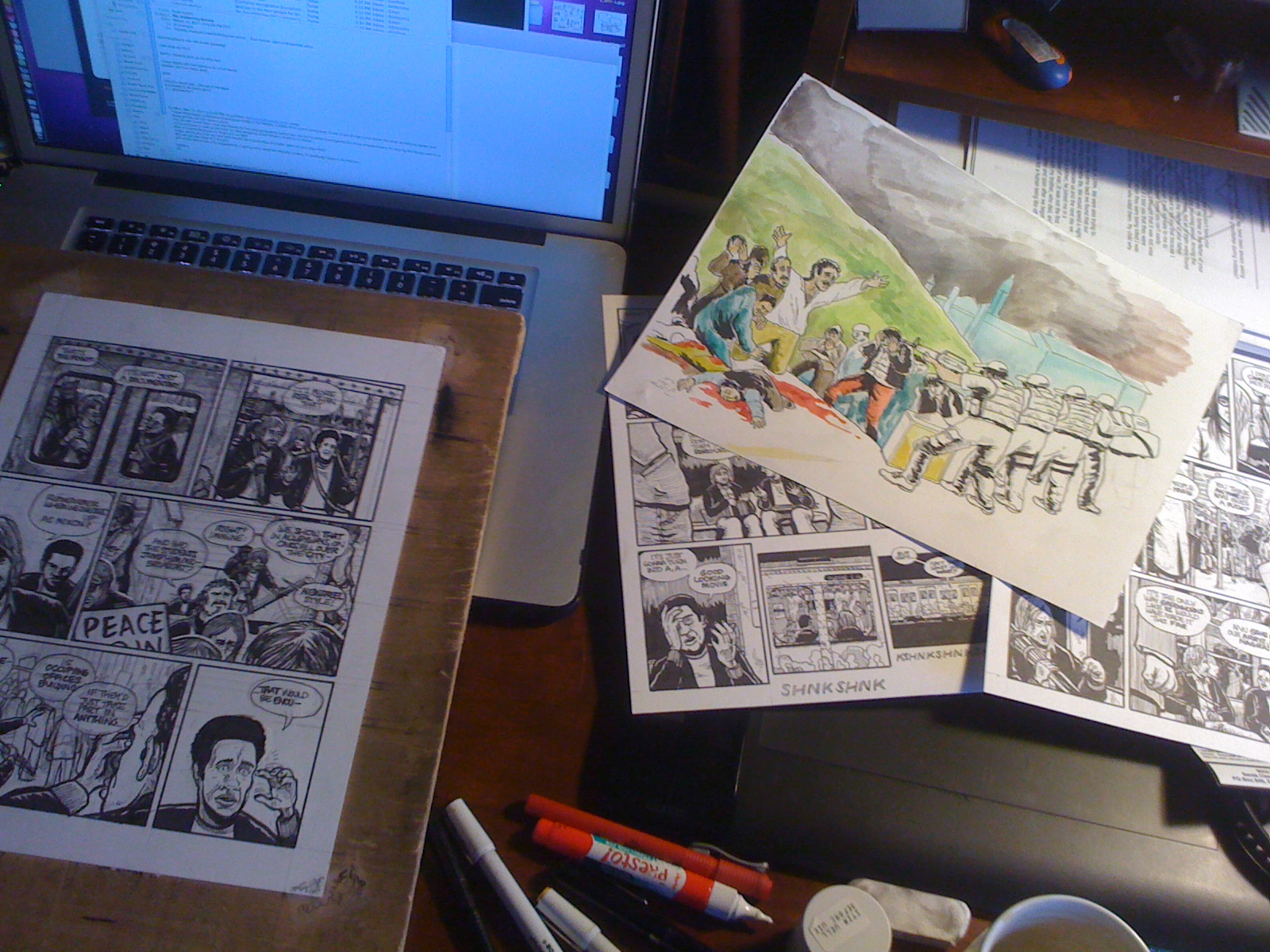
NB the meticulously clean work area
To mix things up, I’ve also finally got around to working on my mashup of Goya’s The Shooting of May 3 1808, which you can see to the right of the pic (experimenting with how well bristol board takes watercolour washes. Results thus far: not so well). My take, if you can make it out, swaps out the spanish and napaloenic troops for iraqis and private contractors – a precursor to my nisour square interactive piece (also in the works), which I’ve mentioned in previous posts.
For more on the project, which is an interactive mini-site, scroll down to read today’s news. For those new to the site, welcome! You can browse and read my comics by hovering over the links at the top and clicking on titles from the drop-down menus.
There’s nothing quite like the race to the end of term to catalyse a depth-charge of creativity. The past few weeks have been busier than normal as I’ve spent hours hunched over final cut and flash (as opposed to the drawing board and scanner), busily hashing out my first mini-interactive documentary site (produced with fellow Knight Madhu Acharya), on Bhutanese refugees and their integration into the Oakland community. The screenshot above gives you an idea of the homepage layout, which in the final published version allows you to choose different chapters of the story to explore. I’m currently tying up loading/streaming issues with the FLV files, but aside from that I think it’s good to go.
Now that I’ve got to grips with Final Cut and Flash, I can move to phase 2 of my project, namely combining video and audio within comics pages to give online readers an interactive multimedia comics experience as they explore news events. Looking back at the “to do” list I put up at the end of January, I’m pleased to say that I’ve hit all the goals:
I’ll next week with news of some future projects, as well as some previews of the above – including my first experiment with text animation in After Effects.

A daily comic from the Archcomix archives (circa 2006) featuring that day's new stories, a la Steve Bell
Last night was my backstory chez Jim Bettinger, our program director, a now time-honoured tradition amongst the Knights when we each take center-stage for an evening to explain how we got into journalism. My talk went well, and led to some good questions about collaboration, multimedia and legal issues around comics journalism. It was also surprisingly satisfying to wade through the murky depths of my early cartooning career to pull out single panel op-ed pieces and chart how I got from there to the longer form work I do today. See attached for some examples from back in the day.
As I tap I’m putting together the final edits on the Bhutanese Refugee story I mentioned last post, which I’m hoping to then import into a flash template ahead of tomorrow’s multimedia class. That’s the plan, anyway. Aside from learning a ton about editing and Final Cut file (mis)management, doing this project has also schooled me in the pain of subtitles, or rather, overdubs. Something that will no doubt become essential training for my future work, which often does feature english as the primary language of interviewees.