To Top
Above is an extract from the final part of the Honduran comic to be translated, providing some historical context to the school of the americas. The observant amongst you will notice the search bar at the top of the window – stick “school of the americas” in there and it’ll bring up all related posts. Many thanks to Apture for such an awesome plugin.
As for news, scroll down to get your fill of this week’s announcements.
As you read each one, think about your reaction to the information, your level of engagement, and the likelihood of you wanting to find out more about this incident. Obviously, the amount of information will provoke a higher level of reader interest, so focus more on what factors are helping you to connect with the story (hint: it’s all about the visuals, as if you didn’t know that from being on this site already). All give different angles on the same incident, which took place almost 3 years ago in Baghdad.
1. From Reuters: July 12 – Photographer Namir Noor-Eldeen and driver Saeed Chmagh, both of whom worked for Reuters news agency, are killed in eastern Baghdad during clashes between U.S. forces and militants.
2. From the New York Times: BAGHDAD, July 12 (2007) — Clashes in a southeastern neighborhood here between the American military and Shiite militias on Thursday left at least 16 people dead, including two Reuters journalists who had driven to the area to cover the turbulence, according to an official at the Interior Ministry.
“They had arrived, got out of the car and started taking pictures, and people gathered,” Mr. Sahib said. “It looked like the American helicopters were firing against any gathering in the area, because when I got out of my car and started taking pictures, people gathered and an American helicopter fired a few rounds, but they hit the houses nearby and we ran for cover.”
3. Reuters again:
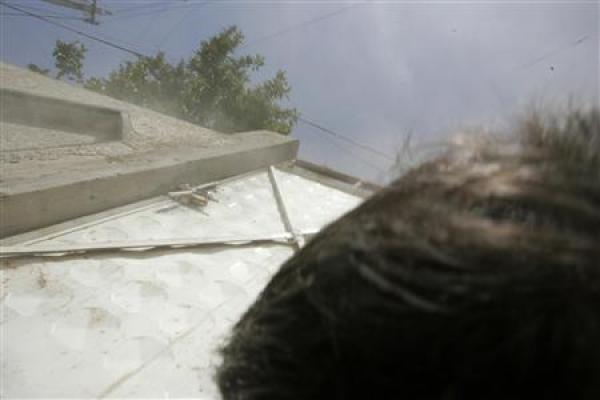
The last photo taken by Reuters photographer Namir Noor-Eldeen before he was killed on July 12, 2007
Photographer Namir Noor-Eldeen, 22, and driver Saeed Chmagh, 40, were killed in Baghdad on Thursday in what witnesses said was a U.S. helicopter attack and which police in a preliminary report called “random American bombardment”. The U.S. military in a statement issued just after midnight on Thursday described the incident as a firefight with insurgents. It has said the killings were being investigated.
“Our preliminary investigation raises real questions about whether there was fighting at the time the two men were killed,” said David Schlesinger, editor-in-chief of Reuters. Residents and witnesses interviewed by Reuters said they saw no gunmen in the immediate area where Noor-Eldeen and Chmagh were killed in Baghdad’s al-Amin al-Thaniyah neighborhood. They said they were not aware of any clashes in the area leading up to the Apache helicopter attack around 10.30 am local time. Noor-Eldeen and Chmagh had gone to the area after hearing of a U.S. air strike on a building around dawn that day.
On Sunday, the U.S. military returned to Reuters two digital cameras that belonged to Noor-Eldeen which were taken by American soldiers from the site of the deaths. No pictures taken by Noor-Eldeen on July 12 show clashes between militants and U.S. forces. The pictures show no gunmen, nor residents running for cover.
The U.S. military said last week it had called in “attack aviation reinforcement” after coming under fire from small arms and rocket-propelled grenades. Nine insurgents and two civilians “reported as employees for the Reuters news service” were killed, the statement said.
4. Video, courtesy of Wikileaks (visit their website for more information on their corporate/governmental whistle-blowing). Released earlier today at a press club meeting in Washington DC, the footage reportedly came through a source with connections to the military and has since been verified as legitimate and been broadcast globally (BBC, CNN, Al-Jazeera…) – here’s a full video report from Al-Jazeera (plus interview with the editor who published it online).
More on this tomorrow, but please post your comments/reactions – and retweet the link.
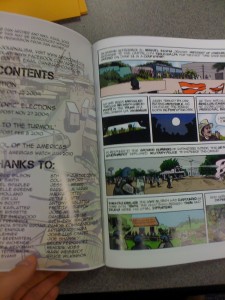 After what felt like an age of translating, tweaking, laying out, re-tweaking and all the rest in photoshop and indesign, I’m proud to announce that the first print run of the Honduran comic is underway as I type this. It should be ready in a few weeks time, so expect your copies around April 20th (US readers) and end of the month (rest of the world). I am now more aware than ever of the inevitable delays in going to print, but having seen one of the vast (almost full US letter size – see left with a stunt hand to give you a sense of proportion) copies in all its technicolour glory, I can tell you it’s well worth the wait. Thanks to Angela Vidergar for correcting my spanish translation for the second part. Now all I need are more orders to ensure I can push up the size of future print runs.
It’s always gratifying to see that it’s not just us self-publishers who are treading the precarious profit trail – apparently as of June, readers of the times in the UK will pay a princely £1 for the privilege of access to www.thetimes.co.uk for a day, or £2 for the working week. Here’s the full skinny, courtesy of that trusted bastion of fine journalism, The Sun. Surely it can’t mean a wholesale lockout/access denied scenario for the more parsimonious amongst us – it’ll probably be a bare bones version with none of the rich content that’s up there at the moment. Question is, will that prompt a split in news content between raw twitter-esque headlines and live feeds, embedded content and video/audio sources? Answers in the comments section. Speaking of which, the illustrious winner of the last post’s quiz on the most corrupt country in the world is…Somalia, closely followed by Afghanistan. The verdant wonderland that is New Zealand sneaked the least corrupt prize.
Perhaps the self-proclaimed “most revolutionary magazine in the world” holds some of the answers to the above question. Launched by Andy Warhol 40 years ago, Interview magazine’s ipad version seems remarkably unrevolutionary from the below video. In fact, the only stand out moments from the slideshow/larger iphone feel of the preview is the embedded live video. Until creators start to rethink the way they create content instead of simply publish it, all this digital innovation will seem like whistle-and-bells add-ons to the existing mode of information delivery. Decide for yourselves below: