To Top
Wow. I know lately I’ve been prone to postponing my once-daily digital diatribes, but the sheer amount of work I’ve been getting through of late has tipped we way over the line. The main reason for that was the big push to the end of my Knight Fellowship at Stanford, which I’ll write more about in detail on my Knight project page. In the meantime, visit this link to watch my 3 min hyper-summary of comics journalism and what I’ve been working on at Stanford. Or click here to see how the rest of my incredibly talented cohort spent their year via the re-engineering journalism Knight Fellowship Garage.
That’s right, click here for the full 1.5 hr audio of “The World in Frames” panel organized at Stanford last week. Featuring Andrea Lunsford (Professor of English), Adam Johnson (Assoc Professor in English and Creative Writing), Adam Rosenblatt (Ph.D. Candidate, Modern Thought and Literature, representing the Program in Human Rights) and, of course, myself (Comics Journalist, John S. Knight Journalism Fellow).
Joe goes into detail on his process, what tools he uses (nibs and paper types, the whole shebang), his influences, and why he chose comics as the medium for his journalism.
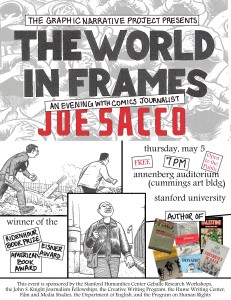
Reminder: myself and various other members of the Stanford comics community will be discussing comics journalism with Joe Sacco at Annenberg auditorium, 7pm tonight. If you’re curious about the above image, it’s a screenshot of my latest interactive prototype, which you can experiment with here. (It’s the most recent one, at the bottom).
I’ve also just contributed my first post to Graphic Journos.com, which is a comics journalism collective featuring Susie Cagle, Wendy Macnaughton, Matt Bors, Jen Sorensen and Sarah Glidden. As if that wasn’t enough, last night (well, technically in the wee hours of this morning, in the longstanding tradition of comics creators everywhere) I finally finished the first part (4o pages) of my graphic novel, “The Hard Hat Riots”, which I’ve co-written with Nikil Saval. More on that soon.
It’s so close I can taste it! One of the concluding panels from the re-drawn part one of my graphic novel-in-progress, Hardhats. See the drop-down menus above for more info on that, and other comics. Also, you can follow me on twitter (@archcomix) or follow the Archcomix FB page here to stay up to date on all comics journalism news and events. Speaking of which – I’ll be on a panel with the legendary comics journalist Joe Sacco at Stanford next Thurs, May 5th at 7pm. Annenberg Auditorium. Hope to see you there!
Check out the recent demos in DC against the School of the Americas, whose involvement in human rights abuses across latin america continues to go unpunished. For more info on the School, renamed the catchier WHINSEC (much like Blackwater’s seismic change to Xe), check out these comics.
And speaking of creative action, kudos to the protestors who heckled Obama at a recent fundraiser in here in San Fran, urging him to reconsider the Pentagon’s harsh treatment of wikileaks whistleblower Bradley Manning, who has done 9 months of solitary in the brig (subject to regular sleep deprivation techniques and often forced to sleep naked) while Julian Assange continues on his PR blitz as the white Martin Luther King. Lyrics below. Admittedly, an expensive strategy (a table at the event reportedly cost $105,000 according to the Guardian UK), although how often is the President forced to stand mute and listen to dissenting (albeit not so tuneful) voices?
Dear Mr President we honour you today,
Each of us brought you $5,000
It takes a lot of Benjamins* to run a campaign
I paid my dues, where’s our change?
We’ll vote for you in 2012, yes that’s true,
Look at the Republicans – what else can we do?
Even though we don’t know if we’ll retain our liberties,
In what you seem content to call a free society.
Yes it’s true that Terry Jones is legally free,
To burn a people’s holy book in shameful effigy.
But at another location in this country,
Alone in a six by 12 cell sits Bradley.
Twenty-three hours a day and night,
The fifth and eighth amendments say,
This kind of thing ain’t right.
We paid our dues, where’s our change?
Thanks to Hal and the Palo Alto Rotary Club for inviting me to talk on Friday – I’m glad that my energetic defence of comics journalism went down well. There’s been a flurry of activity lately on the comics journalism front, perhaps best summed up by the launch of Graphic Journos, a showcase/forum/sounding board for drawn journalistic pieces featuring a handful of up and coming journalists (including myself). Kudos to the ever productive Susie Cagle for getting it off the ground. One of the said journos is Wendy Macnaughton, whose innovative combination of audio and lush watercolours works really well in the video below – the bar has been raised.
Building on my previous post about explainers, I want to continue a conversation I had at last night’s Hacks and Hackers meetup at Stanford. For those of you who don’t know, H&H was set up by Knight Fellow Alum Burt Hurman (now one half of Storify, which just secured a hefty chunk of angel investor funding) to put journos in touch with the coders who can make their stories come alive on the digital page.
Burt and his partner Xavier had come to talk to the Knights earlier in the afternoon about Storify and the challenges of transitioning from journalism to entrepreneur-dom, and I asked about whether it was possible to find coders who were up for smaller project assists without necessarily being promised stock options in a startup before doing so. Well, turns out I might be eating digital humble pie after chatting to some hackers later on that evening – I’ll keep you posted on what comes of our follow-up talks. But I digress…
Talking to a fellow hack after the H&H evening talks were over, we agreed that in this age of shorter and shorter web-based mini-docs and social media-loaded website parsing feeds from You Tube, FB, Twitter et al, ironically enough it’s the storytelling that will continue to determine the quality and calibre of successful journalistic pieces. Admittedly, this is predominantly in the realm of feature-length, more in-depth pieces, and not real-time commentary. But there is a vaguely worrying trend in the idea that simply by tapping into the cloud and wringing out the plethora of quotidian musings from the flannel of the digital hive mind, suddenly journalists can gain access to a new stream of information that is more real and vital than traditional models. I can see the appeal in this model working for events – such as fellow Fellow Jigar Mehta’s popular #18daysinEgypt – but again it relies on a pre-existing knowledge of the circumstances: for locals who know their way around, as opposed to the newbie cyber-tourist dependent on a guidebook (who, more importantly, is subject to the limited timescale -albeit self-imposed- of their online attention span). Particularly at a time when so many are decrying the imminent death of journalism, or claiming that the good ship of traditional reporting has sprung a wikileak, I think it’s worth stepping back and saying that yes, information is now more readily accessible than ever – but that makes the job of curating it all the more important. Correct me if I’m wrong, but Julian Assange is more of a cyber-security guard for Bradley Manning’s whistleblower, and neither of them have taken any steps to interpret any of the hundreds of thousands of leaked memos – they left that to the Guardian, Der Spiegel, etc. In fact, when Wikileaks did try to editorialize their leaked material, they were excoriated by the online community for their removal of several minutes of footage from the now infamous video showing the trigger-happy crew of a US helicopter gunship firing on suspiciously unthreatening civilian targets in Iraq.
Earlier on, I wandered into a semantic minefield by arguing about the “success” of a good piece of journalism. This reminds me of another troubling article (I’m beginning to sound like a paranoid conservative fending off the barbarian e-horde at this point, but anyway) I read recently in the Atlantic about Nick Denton, driving force behind the Gawker empire, and his faith in page views above all else: analytics, as opposed to content, are king. Here’s a video summing up the new Gawker redesign and shift to a more TV-based online approach. To my mind, this can only precipitate a race to the bottom, a pepped-up mixture of instant gratification and restless attention-span pandering that will open still wider the floodgates of paparazzi photos, celeb gossip rumour mill grist and mindless memes. So what is a successful piece? A good story – something that admittedly needs to entertain/interest you enough to keep reading, but that can also -shock horror- force you to challenge your assumptions and learn something. Instead of page views, what about asking readers to check what they’ve gleaned from an article? Cognition experts are almost as ubiquitous as journalism decriers in exposing the slash-and-burn effect all this hyperstimulation and fragmented media in(di)gestion is having on our poor neurons.
From my clearly unbiased point of view, it’s up to us hacks to combine the raw materials of our storytelling expertise with the hackers who can model it in html5 clay into the right vehicle to maximum the potential return (we’re talking knowledge here, not bottom line – that’s a whole nother post) for the reader. Not to get caught up in making the biggest pottery shed so that the world and his wife can come and try their hand at clay-slinging. Like the folks at the Atavist say, a good story is all about getting lost. Without losing your train of thought along the way.
As part of the multimedia jamboree that has come to characterize my project, I’ve been researching the latest techniques that news organizations are using to convey their complex story subject matters to an increasingly time-starved, quick-fix-hungry readership. The key as I see it is to balance an accessible means of delivery (something that doesn’t fall at the first hurdle of being visually horrifying or clunkier than a second-hand skoda) with a message that will stay with the reader for longer than it takes them to drain their latte.
This means content providers being a little more accountable for how the information they’re relaying is being used – after all, a school’s not worth much if its pupils can’t retain the teaching long enough to pass their end of year exams. Yes, you could argue this is less relevant in the second-by-second news cycle, but as we’ve heard time and time again, the up-to-the-milisecond-coverage means little without a healthy working knowledge of the context that it fits into.
Discussing this recently with Josh Kalven, founder of Newsbound, we agreed that game theory could play a crucial part here, inconspicuously cajoling browsers into testing their post-article muscles to see just how many of the key points have stayed with them. Josh has joined the ranks of the visual explainers, creating a company that is “exploring how best to contain and explain complex news narratives“. See below for his first offering, on filibusters:
Of course, we’re not the only ones who have awoken to this new breed of explanatory journalism – indeed Fellow Knight and NPR Marketplace stalwart Paddy Hirsch has made it to the focus of his project, as an offshoot of his highly successful marketplace series of explainers: here’s one on the Double-dip recession from Marketplace:
As I’ve mentioned before, Paddy and I are also working on our own financial crisis explainer, which will be premiering early next month and will be akin to the mongrel offspring of New York Times’ Zach Wise’s after effects animations and Mark Fiore’s more cartoony satire.
Much praise was heaped on John Jarvis (and rightly so) for his uber-slick explainer, “The Crisis of Credit Visualized”, which was his thesis project at the Art Center College of Design in Pasadena. For a behind the scenes look at how the project came together, check out Jarvis’ post here. Jarvis is now part of a group known as The New Mediators who are using graphic design solutions and interactive, rich-media diagrams to bring clarity to complex processes. Next post, coming soon: riding the visual rollercoaster of slickness – and no, that’s not a veiled reference to this very slick interactive timeline of the Middle Eastern Protests from the Guardian. (Although it will feature).
After a brief hiatus, the hardhats story continues: only a few more corrections to go and the WHOLE first part is finally ready to send off. If you’re new to the site, have a look around! Comics are accessible via the drop down menus above (hover over the different categories to choose a subject).
The more observant among you will have noticed that the comic above has not changed in a while. The reason? I left Archbeast I, my brand spanking macbook pro, in the world’s busiest airport (London Heathrow) after spending most of the night before working on a new website launch (about which, more another time). Thankfully it has since been tracked down and will be back safe and sound on the west coast tomorrow, together with my lovely wife. In the meantime, scroll down for news and updates of a more textual variety – alas my scanner and old macbook don’t get on, and Archbeast has all of my new material on. Time for an external hard drive backup methinks.

Photo: @Jasoncuddy via Flickr
This weekend saw one of the biggest protests sweep through London since the Iraq war march of 2003. Dredging through the different coverages, the best seems to come from outside of Blighty, being less bound by the infighting and muckslinging. Here’s background to the 26th of March protest in case you missed it.
From a longer New Statesman article, in turns dismissed as fiction and hailed as honest coverage: ‘’These young people are right to be angry. I don’t think people are angry enough, actually, given that the NHS is being destroyed before our eyes,” says Barry, 61, a retired social worker. “The rally was alright, but a huge march didn’t make Tony Blair change his mind about Iraq, and another huge march isn’t going to make David Cameron change his mind now. So what are people supposed to do?”
Good links in the tweetstream to student protestor eyewitnesses here. Point is, what good did it all do? Once again we see how the actions of just a small cadre of the black bloc (either real or saboteurs) gives ample excuse to all sides for the disproportionately violent response from the police. Looking at the photos from the event, you also have to ask yourself: what proportion of people there were actively participating, as opposed to filming or taking pictures of all this dissidence? It’s enough to make you become a Yes Man.