To Top
Wow, where did January go? I was sure it was here a second ago. It feels like the second semester only just started, and yet here’s Feb knocking on the door and I’m wondering where all my carefully chronicled Knight exploits have gone. So here’s my attempt to sum up what’s happened over the last few weeks at Stanford:
Hmm I’m sure I’ve missed a few things off the list, but that’ll do for now. Oh, and the small matter of figuring out my life post-Knight…

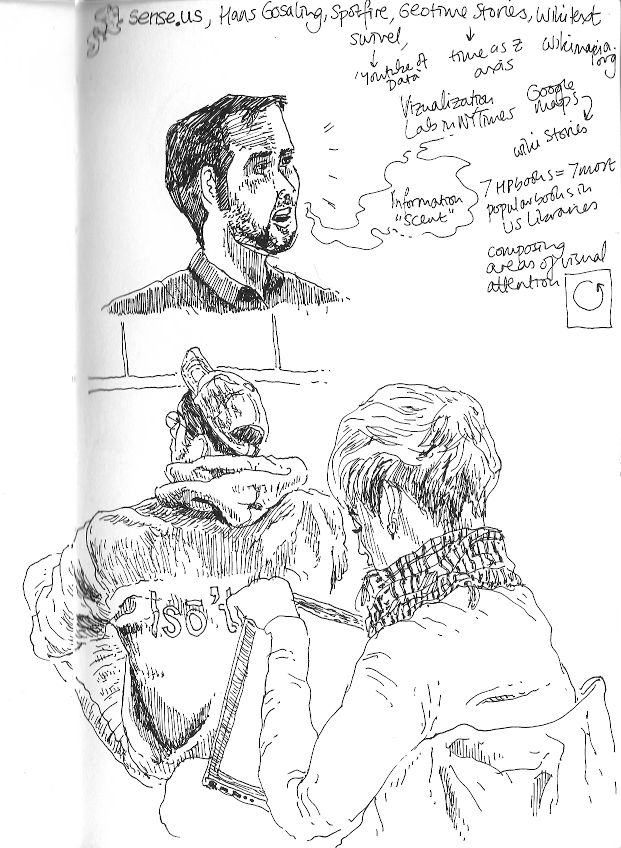
Sketchbook page from last night's Zittrain lecture
In the first of many blogging experiments, and to minimize the amount of time I spend at my computer this semester – not to mention to hone my cartooning skills – I’m going to post pages from my sketchbook from some of the lectures I attend this semester. Last night’s was part of the Liberation Technology series and featured Harvard Law Professor Jonathan Zittrain discussing the ethical pitfalls and perils of crowdsourced jobs – especially ones that seem innocuous at first but actually have nefarious goals. Such as what if the Iranian government (whose involvement would obviously be kept hidden) attempted to identify protestors at a rally by building an entertaining face-matching game, or companies luring “turkers” (from Amazon’s now notorious “mechanical turk” site) to provide bogus product reviews for points or minimal (3-5 cents) return.
We are all complicit when the promise of fake online points prompts gamers to overlook their ethical responsibility to society – check out this so-sinister-it’s-laughable true story of an anti-Health Reform Organization bribing facebook game players with points to send an email to their member of congress decrying the evils of Health Care reform. In a beautiful instance of technology spawning some great metaphorical neologisms, this process is called astroturfing – because it’s fake grass roots campaigning.
Find out more about Zittrain’s book, The Future of the Internet and How to Stop it, here.

Sketches of Condi during our Q&A
The Winter term kicked off this week, and already it feels like I’ve been back ages. In true Stanfordian fashion, yesterday’s highlights included: an introduction to multimedia reporting (hello Final Cut Express), catching up with the globe-trotting antics of the rest of the Knights, planning a group ski trip to Tahoe, reading Jeremy Scahill‘s scathing expose of Blackwater and the role of private security firms in Iraq and Afghanistan, and then sitting down with ex-National Security Advisor and Secretary of State Condoleezza Rice to discuss her take on them. While thinking about how all this fits into my project, and working out which courses to shop. Just your average day back at school really.
Geri Migielicz’s class on Multimedia Storytelling is the definite course highlight of my year, as I’ve been wanting to tinker with video, audio and animation to complement my comics work for a while now. Naturally, a lot of the same compositional/framing devices for comics apply to (and are directly borrowed from) film, so that helps. I’ve been addicted to storytelling shows like this American Life and The Moth podcasts for years (ever since depending on them at White River for accompaniment during the hours spent inking at my drawing board in fact), so it was great to see Jessica Abel and Ira Glass’s Radio: An Illustrated Guide in the syllabus. In fact, just this afternoon a bunch of us are getting together to learn how to make a podcast, courtesy of KBOO Portland Radio Director Jenka Sondenberg – so be sure to come back next week to listen to that. Some of the examples we checked out were the NYTimes Year in Pictures and the media-rich 5 Years Later from USA Today, focusing on the aftermath of Hurricane Katrina. I snapped up my copy of Final Cut Express from the bookstore that afternoon, and have just installed it, though I hear it’s a beast on a par with Photoshop in the menubar/features stakes. We’ll see.
The chat with Condi Rice was another year-long highlight, though the mood in the lounge was a lot lighter than expected when I walked in – probably a strategic decision on Jim and Dawn’s part to mix up the holiday catch-up festivities with an indisputably controversial speaker. Predictably, Condi came across as furiously intelligent, quoting in-depth resolution numbers and bilateral treaties in many of her answers (though arguably few of us could confirm or deny their veracity), and the possessor of a honed rhetoric that was nimbler and more acrobatic than the psuedo-kung-fu hand gestures that accompanied them.
As the first Stanford semester winds up, I’ve been working on my sketching and had the time to start experimenting with some projects I’ve been meaning to get to for a while. But before I get into them, I want to mention the excellent talk we had from Patrick Meier at Ushahidi (Swahili for “witness”) this week. Ushahidi is freeware that allows users to input data points on a map via the web or SMS, and is increasingly being used in crisis situations. Regulars to this site will remember I posted several months ago about its effectiveness in helping emergency forces reach victims in Haiti in the immediate aftermath of the earthquake. Patrick’s talk was insightful (telling us about how the Haiti response team essentially comprised of pizza-hungry undergrads at Tufts university on the east coast, who sat and inputted map coordinates, totally voluntarily, during the crisis); honest (I loved his quote about ‘technology only being 10% of the battle – too often are the solutions to these grand problems – journalism, education, literacy, etc – said to be “solved” by mere programs and software alone); and candid – he made it clear the company still had a long way to go, but was buoyed by the positive response they’d received, if slightly bewildered by the inordinate amount of hype and press. He also mentioned Crowdmap, a spin-off of the Ushahidi platform, and again, totally free, that’s more intuitive and less involved on the front-end for users to set up their own map. As an experiment, I’ve started a human trafficking map in the US (I was going to use the one made by Survivors Connect, but it’s down for some reason) which you can check out – and add to – here. Still early days yet, but I want to build a picture of the main areas for trafficking around the 4 most prominent cities in the US for trafficking. For more on what those are and to learn about the project, go to the “trafficking” page above.
And now, back to the art projects…
The first, and most ambitious, is the largest comics “page” I’ve ever worked on – on a 6 x 8 foot piece of wood, whichI’ve cut into panels, primed with gesso and now pencilled the first wide establishing shot of. It’s of London, if you’re wondering where the title for the video comes from. My goal is to ink it later on today with a FAT sumi brush and a lot of Higgins ink. Stay tuned for the result. I’ve also been putting more time into drawing from life and been looking in particular at the assorted gods of linework: Albrecht Durer and Bernie Wrightson. See below for some samples. Check them all out over at my flickr page.
Above is a screenshot from one of the many hypercomics experiments you’ll find at my online launchpad/testing ground for the comics platform I’ve been working on as part of my Knight fellowship. Click here to visit the site, and please send me your feedback! I’d love to hear it. Those of you die-hard Archcomix fans may have already visited it since I launched it under the radar a few weeks back, but I’ve since added new content, ranging from flash-based scrollable comics to hypercomics.
The idea is to combine the need for context in today’s never-ending torrent of 24 hour news with a more intuitive visual interface that allows for more of a personal connection between the reader and the hundreds of stories they scan each day.
Speaking of new ways to read the news, the more eagle-eyed among you will have also noticed that I’ve added a new “Iphone Apps” page to the site, which houses the first previews of the Honduran coup app that I’ve put together with the help of Chris DeLeon. Not to mention a subtle signpost to you lot to read some of the comics that are published online above – just hover over the tabs at the top and you’ll be shown a range of visual narratives to feast your eyes on. If you enjoy what you see, you can even send a micro (or macro) donation my way using the button on the left hand sidebar. Thanks!

Mark and his Sarah Palin animated nemesis in action
Last Wednesday I was delighted to see that my suggestion of Mark Fiore as a visiting lecturer to our weekly Knight Fellowship seminars became a reality. In case you didn’t know, Mark recently won a Pulitzer prize for non-print based journalism (the category’s only a few years old) – he specializes in animated editorial cartoons, which he puts together in Flash.
Not only was it heartening to see the love and respect he had for the masters of animation (Hanna Barbera, Mel Blanc), but also really impressive to see how he pulls together an entire 2-3 minute animated short every week. Just when I thought making comics was labour intensive, he’s working with voice actors, doing lip synching (keyframe by keyframe – no flash tweening here thankyouverymuch), the lot. Even better was the chance to check out, and see how he builds it up, layer by layer. Here’s one of the many clips he showed us:
Who knows, I might even give a short animation a try – watch this space. That is, if I get a chance in between thumbnailing my latest version of the prototype, which I’ve been working on with fellow fellow Sahar Ghazi. Speaking of Flash, I’ve also stumbled across the perfect prototyping tool for future iterations, involving everyone’s favourite frame-by-frame interface. So long as there’s no code involved, I think I’ll be fine…
I also had a great chat with Dominic Price (one of the developers of the Cloudpad web app from Nottingham University) this morning, who talked me through downloading the code for the latest iteration and the steps I need to get it up and running so I can start bending the code to suit my project’s nefarious needs. To do that, I have to figure out what type of server the Stanford webspace runs on, and some other essential info I’m at a current loss to mention.
More software jiggerypokery today with my first forray into Processing, a data-viz tool aimed at amateur programmers/artists/designers who haven’t got hours of eyeball-searing coding experience. Check out this example for an interactive version of the image above – opens in a new window and play around with moving your mouse around the rectangle, as well as holding it down and moving it. Download this incredible freeware from: www.processing.org
Checkout this video from Soso ltd, a design/multimedia collective who specialize in real-time data viz/performance. In the video below they analyze conversations as they happen to give you lucky viewers an updating feed on the semantic breakdown of each speaker’s language use. More on them and what I’ve been up to in the past week over at the Knight Project page.
The Long Conversion from Sosolimited on Vimeo.