To Top
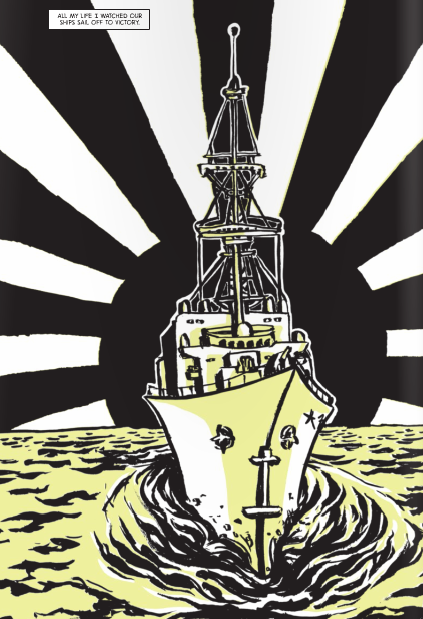
Opening page of Pika-Don by the Stanford Graphic Novel Project
Friday marked the 65th anniversary of the US atomic bombing of Hiroshima, and the first time that a US representative has attended any of the memorial services held in Japan. US Ambassador John Roos was at the service in Hiroshima to observe the moment of silence at 8:15am – the time that “Little Boy“, the most inappropriately named piece of ordinance ever, detonated some 300m above ground level, instantly incinerating an estimated 70,000 people. Click here to read an extract from Pika-Don (“flash-boom”, from the Japanese term for the atomic bombs), created by the Stanford Graphic Novel Project based on double atomic bomb survivor Tsutomu Yamaguchi‘s ordeal and experience the horror of being at ground zero (within 3km) for both blasts. Today at 11:02am will mark the anniversary of the Nagasaki bombing, which was actually 3 times more powerful (20 kilotons) than the Hiroshima blast. Be sure to check out this excellent digital resource from the Nagasaki Archive: a patch for Google earth that lets you explore the shell of the city in the the atomic aftermath.
In more surreal news, ex-Fugee Wyclef Jean is running for Haitian President. Seriously. Despite alleged mismanagement of his charity, his support for the US-backed coup of 2005 that ousted then-President Jean-Betrand Aristride, or – the fact that being a successful pop star does not qualify you to run a country, despite what it may do for your record sales. One-time…
Last but not least, the SOAW (School of the Americas Watch) delegation to Colombia is continuing their protest around US military installations (see video below) in the run up to the Aug 17 Constitutional Court decision that will determine the legal basis of the US military presence in the country and its use of Colombian bases. All the more dramatic, given Saturday’s inauguration of new Colombian President Juan Manuel Santos, who is decidedly more pro-Chavez than outgoing President Alvaro Uribe. Then again, U.S. Ambassador William Brownfield’s comments to local radio station La FM demonstrate the US’s attitude towards the Constitutional Court’s ruling. When asked if a negative decision from the Constitutional Court could affect bilateral relations, Brownfield said, “in absolute terms, I think not.”
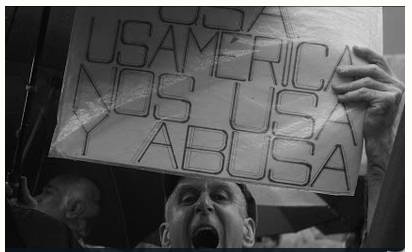
Taken from protest on July 29, photo courtesy of http://nomilitaresencostarica.blogspot.com/
Last month saw the Costa Rican government agree (by 31 to 8 votes) to grant a US military fleet unprecedented access to its waters until the end of the year. Up to 7000 Navy personnel and 20 helicopters thus have the right to “to carry out activities they consider necessary for the fulfillment of their mission, which includes wearing their uniforms while exercising official functions”. This is all against the war on drugs, you understand. Nothing whatsoever to do with the ongoing turmoil in Honduras following ex-President Zelaya’s ousting (for more info, go here) or the larger-scale roll-out of US military presence across Central and South America. Columbia, anyone? Not to mention a recent change of management in the Costa Rican Port Authority:
“The lack of a debate in Congress makes one suspect that they will be operating militarily and not necessarily confined to the drug trafficking operations. Is it a coincidence that ships arrive as a new port management is being put into practice, eliminating the authority of the state agency JAPDEVA (Port Management Board of the Atlantic Coast Development) and its group of unionized dock workers…and preventing any possibility of strikes, work stoppages and incidents in Limón, such as those in Panama? ”
Francisco Cordero-Gené, former head advisor to the Costa Rican legislative assembly during the past two administrations
More on the background to Costa Rica’s uneasy US alliance courtesy of Joe Shanksy at Upsidedownworld. If you’re dubious of the US’s motives in the area and want to take action, then sign the petition here – the chance to do your part (albeit tiny and in e-form) is only a click away.
—————-
My collaboration with Fulbright Fellow Olga Trusova on a comic about human trafficking is now officially out in the open and on the crowdfunding site Kickstarter. Check out our pitch here and help get our comic printed and distributed to raise awareness of this important issue – we’re currently just under a tenth of our goal with 55 days to go. Olga was recently interviewed by the Human Trafficking Project on the background and scope of the project – read all about it here.
—————-
Last but not least, be the first to hear Judge Walker’s decision on the Prop 8 trial tomorrow by clicking here. See below for a comic I originally did in the buildup to the original Prop 8 vote in league with legendary local activists the Raging Grannies. Check out their website here.
[GALLERY=12]
Thank you to all who voted in the Borderland cover design poll: I’m pleased to say that my preferred design, number 8, won with 24% of the vote, closely followed in a dual tie by numbers 1 and 6 with 18%. The final cover artwork is about 90% finished now and I’m really happy with it, so be sure to check back in later on this week when I’ll post a low-res version for your comments. If you’re late to the poll or don’t know what I’m talking about, go here for the designs and here for an introduction to the project. It’ll have its own page soon.
I’ve been making more back-end changes to the site, adding comics here and there from the archcomix archive as well as adding various widgets: check out my flickr stream below on the right as well as new comics (AIPAC in its entirety on the US politics page) and reviews (perma-link to my recent Comics Journal review on the revamped “About” page).
As I near the end of putting Borderland together (my human trafficking comic, for those of you new around here), I’ve been debating various different cover designs, some of which I’ve pencilled at full size only to find that they lack the impact (emotional or visual) I’m looking for. So in keeping with the Honduran coup comic, I’m throwing it open to you: peruse the options below and choose your favourite in the poll underneath. I’ll reveal the winner in a few days, as the cover is due by the middle of next week.

1. Half realistic portrait of one of the victims, the other half filled in with a map of Eastern Europe/Ukraine against a black background.

Cover 2: Similar to the Honduran Coup cover: reflections of imminent danger in the close-up eye of one of the victims

Cover 3: Understated. Assorted items presumably belonging to a victim - passport, identity papers, etc with "Borderland" rubber-stamped on top

Cover 4: Scattered ID papers belonging to the 7 different victims whose stories comprise the comic. A bit cluttered perhaps.

Cover 5: The victims walking towards us down a typical Ukraine high street with Kiev landmarks in the background. Subtle nods to the locations mentioned in the stories (nightclub signs, bakery etc).

Cover 6: The victims in the foreground, overshadowed by the different buildings that constitute their homes/work/prisons in the comic

cover 7: A beaten-up, weathered Ukrainian passport (in dark blue), which you open up to see the contents laid out like a passport (photo ID, DOB etc) Cons: Passport cover design alone not enough to grab a reader's attention.

cover 8: my favourite (no bias). The black is a Ukrainian passport, with assorted mocked-up papers/ID photo stapled over the top, as if we were the case worker for one of the victims.
Harvey Pekar, the legendary underground comics writer and creator of the American Splendor series, was found dead at his Cleveland home earlier today. Pekar was an uncompromising champion of the American everyman, most famously in his tirades on the David Letterman show (see clip, left) and candid disregard for celebritydom and its trappings. I was lucky enough to collaborate with Harvey earlier this year on one of his final projects, a history of Yiddish literature and culture, which will be out in the Fall. Go to the social histories page for more extracts of Yiddishland, and RIP one of comics’ true greats.
Update: Above are sample panels from Yiddishland. As you may have guessed, the site is currently undergoing a redesign and I’m still ironing out some kinks, with the help of Stanford CS student Alex Easton. Thanks Alex!
Was what Nikil and I were treated to on Friday night, at Studio 40 in the mission. Both Eric Drooker and Seth Tobocman are comics art activists who have been in the game for more than a few decades now. Drooker has a long history of doing beautiful painted covers for the New Yorker (“undermining the mainstream”, as he calls it) while Tobocman is a self-professed radical who wears his politics very much on his sleeve.
Here’s a clip to give you a sense of what his performance was like.
Tobocman is also one of the founders of the political comics anthology World War 3 Illustrated, which will hopefully be running one of my pieces in their next issue.
His latest book, Understanding the Crash, uses his aggressive stenciling and arresting visuals to explain the economic flatline the US economy is currently straining to recover from and the roots of the housing crisis, which Seth puts down to the prevalence of “flipping”. That is, people mortgaging their first home in order to buy a second home so they can sell it quickly for a profit. Drooker showed us his photos from a recent trip to Gaza, where he joined local communities in painting on the towering Israeli security wall that looms over their homes. With an electric banjo accompaniment, he also showed us wordless panels from his latest collaboration with the folks at City Lights on an illustrated version of Ginsberg’s Howl, as well as his latest wordless graphic novel, Blood Song.
For more, voila: Eric Drooker and Seth Tobocman‘s websites.
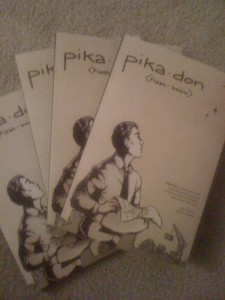 Pika-Don (“Flash-boom” in Japanese, the name given to the atomic bomb blast), the fruit of the SGNP’s labours over the past 6 months, is finally back from the printers!
Feedback so far has been overwhelmingly positive, so here’s to us finding a home for it at a publisher soon. For more info on the SGNP and its incredible 2010 students, check out this video.
For those of you who aren’t familiar with the back story to the coup in Honduras that happened a year ago today, here’s a short and sweet video synopsis for you. The music is “Innocence” by “Working for a Nuclear Free City” off their “Businessmen and Ghosts” album.
Please digg/tweet/FB/fwd the link on and here’s to the ongoing struggle for justice that rages on in the face of continued repression.
More for Torture Awareness Month: Just when the US’s “checkered” (read: conspicuous) history of using “coercive techniques” (read: torture) to protect national security in the wake of 9/11 had your constitutional spidey-senses collectively tingling, recently published evidence suggests that government agents went even further. Physicians for Human Rights are behind a mini-site called “The Torture Papers”, which claim that “CIA medical personnel allegedly engaged in the crime of illegal experimentation after 9/11, in addition to the previously disclosed crime of torture.” Their goal? To make the process as effective and invisible as possible. Apparently the scope they’d been afforded by the Torture Memos wasn’t broad enough. That is, that in order to constitute torture, the pain suffered must be:
“equivalent in intensity to the pain accompanying serious physical injury, such as organ failure, impairment of bodily function, or even death.”
Read the full memos for yourself below.
It’s nose to the grindstone time at Archcomix HQ (temporarily based out of Ithaca, NY for the next 2 weeks), as I’m fighting to reach my daily goal of 1.5 pages of Borderland (my human trafficking comic), inked and penciled. So far, so good – even managed to get some done in Detroit airport at 6 in the morning. Just finishing a story about a worker who was kept enslaved at a Polish bakery and about to move on to a construction worker who was treated like an animal in one of Moscow’s most prestigious patches of real estate.
On a more upbeat note, my Knight Fellowship for 2010 is now only a summer away, so I thought I’d shed a little more light on the program and give you a chance to see what previous fellows spent their year working on.
June is Torture Awareness Month, so at the very least you can check out this video from the National Religious Campaign Against Torture. (Yes, even if you’re a devout pagan). Here’s a good place to start if you’re new to the US’s private use and public condemnation of torture. As for the discrepancy over why the debate over torture continues to preclude taking any actual steps to end it, check out this article from Slate on Maher Arar, best summarised by this quote:
Each time an American court declines to address this issue because it’s novel, or complicated, or a matter best left to the elected branches, it reaffirms yet again that there is no precedent for doing justice in torture cases. By declining to find torture impermissible, they are helping to make it acceptable…Given that [torture is illegal], he wondered, why was the majority of the panel searching high and low for some diplomatic, national security, or supersecret policy reason to defer to the other two branches of government to set the parameters of U.S. torture policy. There is no U.S. torture policy. We don’t torture. So why are the courts leaving it to Congress to set its boundaries?
Which is all the more interesting in light of Ex-VP Dick Cheney’s comments from last year on Fox News, as reported by the NYTimes:
“I knew about the waterboarding, not specifically in any one particular case, but as a general policy that we had approved,” said Mr. Cheney, who noted that neither a gun nor a drill had actually been used on detainees. “The fact of the matter is the Justice Department reviewed all those allegations several years ago…
…The judgment was made then that there wasn’t anything that was improper or illegal”
You have to love that relative clause in the first sentence. Move over Jack Bauer, Fox has a new all-american hero re-writing its constitution.