To Top
If you’re looking for more information on my latest human trafficking comic, Borderland, then go here. Most importantly, please pre-order our comic through Kickstarter so we can meet our fundraising goal and get it printed and distributed here in the US to raise awareness about human trafficking. A big thank you if you’ve already pledged. Us independent creators would not exist without your support.
If you want to see the latest installment of stop motion genius from some more of the 8th graders I’ve been teaching, then go here for “Mr Toast”.
Featuring artwork from one of the victims interviewed, part of one of the many anonymous surveys we drew our research from, as well as statistics from the IOM, I think this idea has more visual impact and sums up the aims of the comic (both educational and emotional) better than the other options you could have voted for. Please leave feedback below!
Meeting Eric Drooker last week got me thinking back to my experiments with wordless comics, which peaked with the above piece for Bash magazine in Dec 2008. So much was being said about the then imminent financial crisis, I thought a wordless approach with all of its symbolic ambiguities was a novel way of pointing the metaphorical finger at the Credit Default Swapping troublemakers. Scroll down for lots of updates below the fold, and don’t forget to cast your cover design vote for my Borderland comic – voting closes in a few hours.
Panel 1: Obama quote from NPR
Panel 8: Kessler appears in this video of the recent AIPAC 2010 Student summit at 3:56:
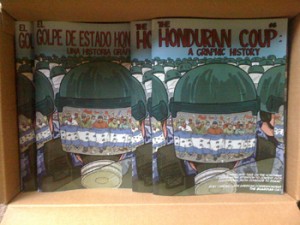 At last, the comics are now back from the printers and I’m glad to say they look great. They are currently being stuffed into envelopes and will be with those of you who ordered them next week. If you haven’t ordered one, then click on the button on the right-hand sidebar and do so immediately.
Now that the Honduran comic is at last completed, I’m re-focusing on my graphic novel, Hardhats, about the 1970 Hardhat riots and the parallels between the anti-war movements then and now. Click on the ‘Hardhats‘ tab at the top of the page for more info and to read an extract, which I’ll be adding more panels to over the next few months. You’ll also be able to check out all the research that’s going into the book and offer your comments and suggestions on what should or shouldn’t go in.
Big news this week in journalistic circles was the announcement that the Pulitzer prize for editorial cartooning has gone to an animator, the first time in history that the prize has gone to someone whose work only appears online. The judges went on to say “[Fiore’s] biting wit, extensive research and ability to distill complex issues set a high standard for an emerging form of commentary. Let’s hope this leaves the door open for other like-minded visual distillers of complex issues – certainly comics journalist Joe Sacco winning the Ridenhour Prize for investigative reporting is a similar step in the right direction.
At last, a sign that innovation and creative use of multimedia in visual journalism is being rewarded -not to mention, taken seriously- by the industry. The winner, Mark Fiore, has loads of free animations available to view over at his website, so check them out. Question is, how different are Mark’s animations to single-panel/editorial gag cartoons? Is their purpose to inform or entertain? Certainly they’ve managed to stir up their fair share of controversy. With the advent of the ipad, you’d think this sort of content would be embraced with open arms by the tech companies, but news came this week that Apple have blocked Mark’s ipad app on the grounds that:
“Applications may be rejected if they contain content or materials of any kind (text, graphics, images, photographs, sounds, etc.) that in Apple’s reasonable judgement may be found objectionable, for example, materials that may be considered obscene, pornographic, or defamatory.”
More on this story at the Columbia Journalism review. UPDATE: Looks like it won’t be long before Apple let Fiore’s app in after all, even though it took Steve Jobs himself to intervene.