To Top
Featuring artwork from one of the victims interviewed, part of one of the many anonymous surveys we drew our research from, as well as statistics from the IOM, I think this idea has more visual impact and sums up the aims of the comic (both educational and emotional) better than the other options you could have voted for. Please leave feedback below!
As I near the end of putting Borderland together (my human trafficking comic, for those of you new around here), I’ve been debating various different cover designs, some of which I’ve pencilled at full size only to find that they lack the impact (emotional or visual) I’m looking for. So in keeping with the Honduran coup comic, I’m throwing it open to you: peruse the options below and choose your favourite in the poll underneath. I’ll reveal the winner in a few days, as the cover is due by the middle of next week.

1. Half realistic portrait of one of the victims, the other half filled in with a map of Eastern Europe/Ukraine against a black background.

Cover 2: Similar to the Honduran Coup cover: reflections of imminent danger in the close-up eye of one of the victims

Cover 3: Understated. Assorted items presumably belonging to a victim - passport, identity papers, etc with "Borderland" rubber-stamped on top

Cover 4: Scattered ID papers belonging to the 7 different victims whose stories comprise the comic. A bit cluttered perhaps.

Cover 5: The victims walking towards us down a typical Ukraine high street with Kiev landmarks in the background. Subtle nods to the locations mentioned in the stories (nightclub signs, bakery etc).

Cover 6: The victims in the foreground, overshadowed by the different buildings that constitute their homes/work/prisons in the comic

cover 7: A beaten-up, weathered Ukrainian passport (in dark blue), which you open up to see the contents laid out like a passport (photo ID, DOB etc) Cons: Passport cover design alone not enough to grab a reader's attention.

cover 8: my favourite (no bias). The black is a Ukrainian passport, with assorted mocked-up papers/ID photo stapled over the top, as if we were the case worker for one of the victims.
In case you missed it, voting is still open for your favourite cover design of the four that I posted on Friday – scroll down to view them, then leave a comment or vote using this here link.
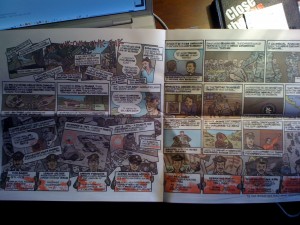
The School of the Americas comic is now in print as the full-colour centrefold (now then) of the latest issue of Presente!, the School of the Americas Watch newsletter. Here it is in all its tactile glory on my desk. Order your free copy and find out more about the SOAW here.
And in case you’ve had your head in the sand the last few days, or are an ardent global warming naysayer (not that there’s much of a difference, admittedly), spare a thought for the poor souls in Chile, who are reeling from one of the strongest earthquakes in recorded history that has destroyed 1.5 million homes and left 700 dead, with the toll expected to rise. It turns out that the strongest ever earthquake (a massive 9.5 on the Richter scale) also hit Chile, some 50 years ago, making it the go-to place for seismologists to conduct research. So thankfully, emergency procedures and containment plans for recovering from such a disaster were already in place and no doubt saved a large number of lives. More on this from the BBC here.
Naturally, comparisons have immediately been drawn between the devastation in Haiti and Chile. Despite Chile’s quake being 5 times stronger, the damage is considerably less than January’s quake, largely due not only to the fact that the epicentre of the Haitian quake was much closer to the surface, but also to the far more advanced construction of Chilean buildings (for reasons outlined above). Another point also worth bearing in mind is the rapid, efficient response of Chilean President Michele Bachelet to the disaster: she held off immediate foreign aid for fear of complications; ordered police to allow victims free access to essential supplies from supermarkets; and was soon offering minute-by-minute updates on the recovery efforts. A far cry from the debacle in Haiti, where international efforts were complicated by the US unilateral takeover of the main airport and subsequent diversion of non-US approved flights, plus the worrying number of US troops (reportedly around 10,000) who were deployed ‘for security purposes’. Surely emergency disaster relief is the UN’s chief role? So it would seem on their website.
Saddest of all is the ‘satire’ of Pat Robertson’s now legendary diatribe against Haiti, which some eager blogger cut and pasted to fit the latest Chilean disaster. Sadder still is that so many in the blogosphere fell for it (here’s the full summary), taking it as a real report. Staying with Chile, below is a comic from the archive that I put together about the US involvement in the 1973 Chilean coup that ousted Salvador Allende. My thoughts, condolences and best wishes go out to those affected in Chile.
[GALLERY=2]