To Top
Building on my previous post about explainers, I want to continue a conversation I had at last night’s Hacks and Hackers meetup at Stanford. For those of you who don’t know, H&H was set up by Knight Fellow Alum Burt Hurman (now one half of Storify, which just secured a hefty chunk of angel investor funding) to put journos in touch with the coders who can make their stories come alive on the digital page.
Burt and his partner Xavier had come to talk to the Knights earlier in the afternoon about Storify and the challenges of transitioning from journalism to entrepreneur-dom, and I asked about whether it was possible to find coders who were up for smaller project assists without necessarily being promised stock options in a startup before doing so. Well, turns out I might be eating digital humble pie after chatting to some hackers later on that evening – I’ll keep you posted on what comes of our follow-up talks. But I digress…
Talking to a fellow hack after the H&H evening talks were over, we agreed that in this age of shorter and shorter web-based mini-docs and social media-loaded website parsing feeds from You Tube, FB, Twitter et al, ironically enough it’s the storytelling that will continue to determine the quality and calibre of successful journalistic pieces. Admittedly, this is predominantly in the realm of feature-length, more in-depth pieces, and not real-time commentary. But there is a vaguely worrying trend in the idea that simply by tapping into the cloud and wringing out the plethora of quotidian musings from the flannel of the digital hive mind, suddenly journalists can gain access to a new stream of information that is more real and vital than traditional models. I can see the appeal in this model working for events – such as fellow Fellow Jigar Mehta’s popular #18daysinEgypt – but again it relies on a pre-existing knowledge of the circumstances: for locals who know their way around, as opposed to the newbie cyber-tourist dependent on a guidebook (who, more importantly, is subject to the limited timescale -albeit self-imposed- of their online attention span). Particularly at a time when so many are decrying the imminent death of journalism, or claiming that the good ship of traditional reporting has sprung a wikileak, I think it’s worth stepping back and saying that yes, information is now more readily accessible than ever – but that makes the job of curating it all the more important. Correct me if I’m wrong, but Julian Assange is more of a cyber-security guard for Bradley Manning’s whistleblower, and neither of them have taken any steps to interpret any of the hundreds of thousands of leaked memos – they left that to the Guardian, Der Spiegel, etc. In fact, when Wikileaks did try to editorialize their leaked material, they were excoriated by the online community for their removal of several minutes of footage from the now infamous video showing the trigger-happy crew of a US helicopter gunship firing on suspiciously unthreatening civilian targets in Iraq.
Earlier on, I wandered into a semantic minefield by arguing about the “success” of a good piece of journalism. This reminds me of another troubling article (I’m beginning to sound like a paranoid conservative fending off the barbarian e-horde at this point, but anyway) I read recently in the Atlantic about Nick Denton, driving force behind the Gawker empire, and his faith in page views above all else: analytics, as opposed to content, are king. Here’s a video summing up the new Gawker redesign and shift to a more TV-based online approach. To my mind, this can only precipitate a race to the bottom, a pepped-up mixture of instant gratification and restless attention-span pandering that will open still wider the floodgates of paparazzi photos, celeb gossip rumour mill grist and mindless memes. So what is a successful piece? A good story – something that admittedly needs to entertain/interest you enough to keep reading, but that can also -shock horror- force you to challenge your assumptions and learn something. Instead of page views, what about asking readers to check what they’ve gleaned from an article? Cognition experts are almost as ubiquitous as journalism decriers in exposing the slash-and-burn effect all this hyperstimulation and fragmented media in(di)gestion is having on our poor neurons.
From my clearly unbiased point of view, it’s up to us hacks to combine the raw materials of our storytelling expertise with the hackers who can model it in html5 clay into the right vehicle to maximum the potential return (we’re talking knowledge here, not bottom line – that’s a whole nother post) for the reader. Not to get caught up in making the biggest pottery shed so that the world and his wife can come and try their hand at clay-slinging. Like the folks at the Atavist say, a good story is all about getting lost. Without losing your train of thought along the way.
 This week has been crazy with the Knight Fellowship shifting into gear and sorting out my battle plan for courses: multimedia, digital video, human rights journalism and a possible intro to neuroscience.
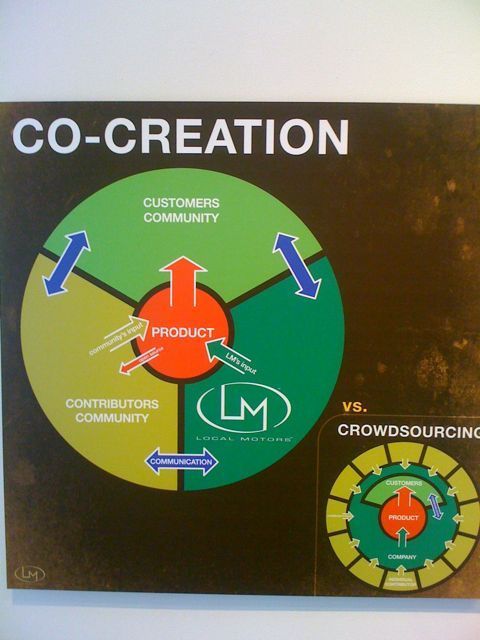
Yesterday’s field trip to the city was great for the chance to visit the Yerba Buena Center for the first time, where we checked out the TechnoCraft Exhibition – a nod in the right direction towards all things crowdsourced, collaborative, hacked, modified and prototyped. Some of the products included: the design your own Puma shoe (in a bizarre partnership with Mongolian BBQ); hacked chairs made from assorted chair entrails scattered throughout London; and a company that allows you to custom-build your own fibreglass car (using the model to the left). Inspiring, but the price tag on all of the above was a bitter reminder of the niche elite urbanite target market for all this supposedly rethought design. Even if it is made out of a freight lorry’s tarpaulin cover.
I’ve been meaning to post this link on the two-fold face of digital activism, which, according to Gaurav Mishra of Gauravonomics is either:
1. you work with a disadvantaged group that suffers from limited access to even the most basic information and tools for self-expression. or 2. you work with a group that is anything but disadvantaged. This group is at ease with using always on internet and mobile devices, both for instantaneous access to information and for self-expression and social interaction. Here, the digital activist isn’t trying to solve a crisis of capability, but a crisis of caring.”
Needless to say, my Knight project is focused on the latter, bedecked as they might be in their custom-built Pumas.