To Top
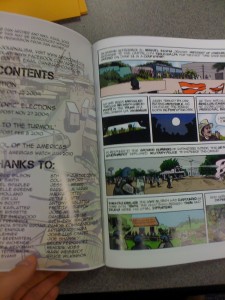 After what felt like an age of translating, tweaking, laying out, re-tweaking and all the rest in photoshop and indesign, I’m proud to announce that the first print run of the Honduran comic is underway as I type this. It should be ready in a few weeks time, so expect your copies around April 20th (US readers) and end of the month (rest of the world). I am now more aware than ever of the inevitable delays in going to print, but having seen one of the vast (almost full US letter size – see left with a stunt hand to give you a sense of proportion) copies in all its technicolour glory, I can tell you it’s well worth the wait. Thanks to Angela Vidergar for correcting my spanish translation for the second part. Now all I need are more orders to ensure I can push up the size of future print runs.
It’s always gratifying to see that it’s not just us self-publishers who are treading the precarious profit trail – apparently as of June, readers of the times in the UK will pay a princely £1 for the privilege of access to www.thetimes.co.uk for a day, or £2 for the working week. Here’s the full skinny, courtesy of that trusted bastion of fine journalism, The Sun. Surely it can’t mean a wholesale lockout/access denied scenario for the more parsimonious amongst us – it’ll probably be a bare bones version with none of the rich content that’s up there at the moment. Question is, will that prompt a split in news content between raw twitter-esque headlines and live feeds, embedded content and video/audio sources? Answers in the comments section. Speaking of which, the illustrious winner of the last post’s quiz on the most corrupt country in the world is…Somalia, closely followed by Afghanistan. The verdant wonderland that is New Zealand sneaked the least corrupt prize.
Perhaps the self-proclaimed “most revolutionary magazine in the world” holds some of the answers to the above question. Launched by Andy Warhol 40 years ago, Interview magazine’s ipad version seems remarkably unrevolutionary from the below video. In fact, the only stand out moments from the slideshow/larger iphone feel of the preview is the embedded live video. Until creators start to rethink the way they create content instead of simply publish it, all this digital innovation will seem like whistle-and-bells add-ons to the existing mode of information delivery. Decide for yourselves below:
I’ve finally come good on my promise to translate the rest of the Honduran coup comic into spanish, which the polyglots amongst you can read here. Feel free to send me any corrections, suggestions or translation errors that may have slipped past my iron-clad grammatical grasp. I’ve also added a Honduran comic thread to the discussion forum on the Archcomix page, so click here and get posting on it. The other big news is that Ryuhei Okada of the Caracas Cafe blog has offered to translate the Honduran coup comic and Right to Return into japanese, so big thanks to him.
Lately I’ve been looking into how animators around the world have been combining narratives with a journalistic message to give a different perspective on news issues and show us what life is like in typically inaccessible parts of the world. One striking example is Fatenah (left) from Palestine, telling the story of a young girl of the same name who’s grown up in the Gaza strip.
Speaking of bringing stories to life, I also recently came across Google’s living stories, part of an online experiment that houses all the contextual information to a specific news story in the same template, similar to a google wave document in a lot of ways. Granted, it still suffers from the same scroll down beyond the break ad infinitum of standard online news sources, but it’s certainly a start. Let me know what you think in the comments section. More cartoons and sequential journalism later on tomorrow.
As you’ll have seen above, the cover to the Honduran Coup: A Graphic History is now finished, and patiently awaiting a journey to the printers. There’s nothing quite like drawing a crowd of riot police to get you thinking about civil disobedience and the concomitant governmental responses, especially in conjunction with an unnerving yet fantastic piece in the March issue of Harper’s Magazine that I came across recently.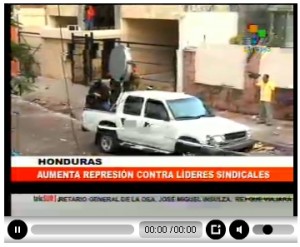 The article’s about the development and proliferation of non-lethal weapons for crowd control and ‘peaceful engagement’ of civilian protests, and cites numerous examples of these cuddly alternatives such as the LRAD (Long Range Acoustic Device) and the neuro-chemical agent that reportedly played a pivotal role in ending the Chechen Hostage Crisis. Killing most, if not all, of the hostages in the process. Readers of this blog will also remember the LRAD’s role in the Honduran coup crisis, one which was actively denied by the de facto regime despite televised images such as this one (see left) being broadcast by Telesur. Its ear-shattering debut on US soil was at the Pittsburgh G20 protests, which you can witness below for yourself.
For the long wishlist of other techno-gadgets that every repressive government shouldn’t be without, click here. Granted, it’s from 2003 – from “Nonlethal Weapons: Terms and References,” a report published by the United States Air Force Institute for National Security Studies – and many on the list are still at the ‘proposal’ stage, but it’s good to see security officials really getting creative with their futuristic weaponised fantasies.
My personal favourite is under the ‘Holograms’ section entitled, Prophet: The projection of the image of an ancient god over an enemy capital whose public communications have been seized and used against it in a massive psychological operation. Doctor Manhattan eat your heart out.
Speaking of imaginative flights of fancy when it comes to security, Secretary of State Clinton is currently on a tour of central america and stopped off in Guatemala where she wished Honduran ‘President’ Pepe Lobo well and urged the rest of Latin America to take his government seriously. Or recognize them, for a start. She told those assembled (including Lobo himself) “We support the work that President Lobo is doing to promote national unity and strengthen democracy,” and went on to say that the US is restoring all aid to the country. No matter that the human rights situation in the country continues to worsen by the day, prompting first the Director of Human Rights Watch to write to the Honduran Attorney General and now nine members of congress to write directly to Clinton to investigate the abuses. Here’s their letter.
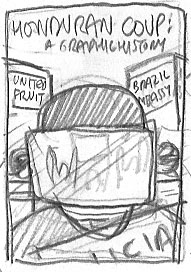 Thank you to those of you who voted for the cover design this week. After tallying up the combined interactive might of facebook comments, comments on my website (always looking for more, polls aside) and the poll I posted a link to, we have a clear winner. Number 3!
Justifying reasons included: it jumps out at you; it’s got more visual impact; it puts you directly in the scene; it’s more dynamic than the other designs. I have to confess, I was all for the first design (sort of a cast of characters lined up), until the votes made me reconsider just how effective (as opposed to informative) it was. So I’m proud to announce that no.3 has already been on my drawing board and is primed for the scanner – the full colour version should be up on Friday, so be sure to check back in and leave your comments then.
Speaking of impacting visuals, I recently came across the amazing talents of Kseniya Simonova, the winner of (dare I say it) Ukraine’s got talent. Her talent? Creating a live animation (that’s in 8 minutes of real-time) about the devastation wrought in the Ukraine during World War 2. Not the first time that the ‘…’s got talent’ franchise has brought millions to tears, but thankfully the first when they’ve actually been genuinely moved and -dare I say it – been intellectually engaged at the same time. But don’t take my word for it – here’s her in action in the final.
It’s an interesting trend that seems to have also caught on over at the Guardian UK, where Patrick Blower has created a niche column called ‘Live Draw’ that uses time-lapse photography coupled with screen capture to show readers how his editorial cartoons are created, line by line. Checkout his recent ‘Alice in Blunderland’ cartoon or the archive. Interesting how he’s referred to as a ‘cartoonist’ and a ‘multimedia artist’ – presumably ‘multimedia cartoonist’ is too much of a mouthful. Comparing the two, I think the real seductive power lies in the sequential narrative that’s being created – Blower includes single panel gags that he builds up over the course of a minute, but these aren’t anything as powerful or entertaining as his tableaux that incorporate different scenes and viewpoints, like this introductory animation on his website’s homepage. The challenge now is to incorporate more of a didactic element into these multimedia creations – to give new readers/members of the audience an introduction to the content or themes that appear in the work, or at least a way of following up if their interested is piqued.You’ll notice that only a handful of the comments in Blower’s Alice animation even acknowledge the piece’s status as a cartoon – it’s more soapboxing back and forth than anything, so obviously it’s appealing to an audience already familiar with the issue. I wonder how the approach could be altered to bring politics to life for someone whose not politically engaged. Suggestions? Stay tuned for my tentative experiments with a similar process in the future.
As mentioned yesterday, I’m looking for bilingual spanish/english readers to spot any translation problems in the page above. Leave a comment with your constructive criticisms, gente. Gracias! More news below, plus a poll for you to vote on.
In a bizarre twist ripped straight out of a Peter Sellers film, Israeli citizens are coming forward in relation to the recent murder of a Hamas arms supplier in Dubai. Get the lowdown in my original post from Thursday. Why? Because their passports put them at the scene of the crime after the assassins cloned them and stole their identities. Leaving people like poor Melvyn Mildiner, 31, to now be fearing for his life, despite having never left the house. Though interestingly there’s this reported quote from ynet.com that he ‘awoke to a world of fun’. Whatever gets you going Melvyn.
For those of you still scraping your jaws off the floor from the now infamous Supreme court ruling that uncapped corporate electoral spending, the democrats have awoken from their shock to suggest some counter-measures. Read about them here.
And whilst my Honduran coup comic is now almost finished and primed for the printers (for more info on it click here), the violent repression of resistance members in Honduras continues unchecked by the media. For a brutal wake-up call, a list of the reported incidents has been published and updated here.
Panel 10: The yellow quotes here are taken from the Washington Post and Fox News coverage. The 15 countries claim is from the Morning Star.
Panel 11: More on this corrosive decision for democracy here.
This concludes the graphic history of the Honduran Coup. For more comix, check out the comix archive for all my comics journalism.
Remember to scroll down to read my latest comments on news stories and visual journalism from around the world. Or you could just click here.
Panel 7: For a graphic history of the School of the Americas, and the link between its graduates and human rights violations, click here.
Panel 8: For more info on the Honduran Military’s presence at PANAMAX, go here.
Panel 9: Direct quote from President Obama on June 29th, the day after the coup that ousted Zelaya.
Panel 1: Seen here with the report is IACHR President, Luz Patricia Mejia Guerrero. Here’s the full report.
Panel 5: News of this predictable yet disturbing development here.
Panel 6: Depicted here is Jorge Rivera Aviles, Chief Justice of the Honduran Supreme Court. For more on his decision, click here.