To Top
Loads of news to fill you in on today – Honduran Resistance Members’ insights into the situation on the ground and the gathering momentum for the constitutional reform petition; the Dalai Lama’s talk at Stanford this morning (off to the next one this afternoon) and about to go to veteran US intelligence officer Ray McGovern’s talk at the Stanford Law School. Only at Stanford could you go from a CIA officer to the Dalai Lama via a brief stroll across campus. I’ll type it all up this evening in between the gargantuan amount of comics I have to spray paint ahead of APE this weekend.
The more observant among you will notice the addition of a subtle “support comics journalism” widget on the left-hand sidebar. If you’re a regular visitor to the site or have enjoyed what you’ve read then please help keep the site going by chipping in a few cents. Every little micropayment helps. If you’re into the big bucks, then just head to the store and you’ll get a hard copy of the comics for your hard-earned cash.
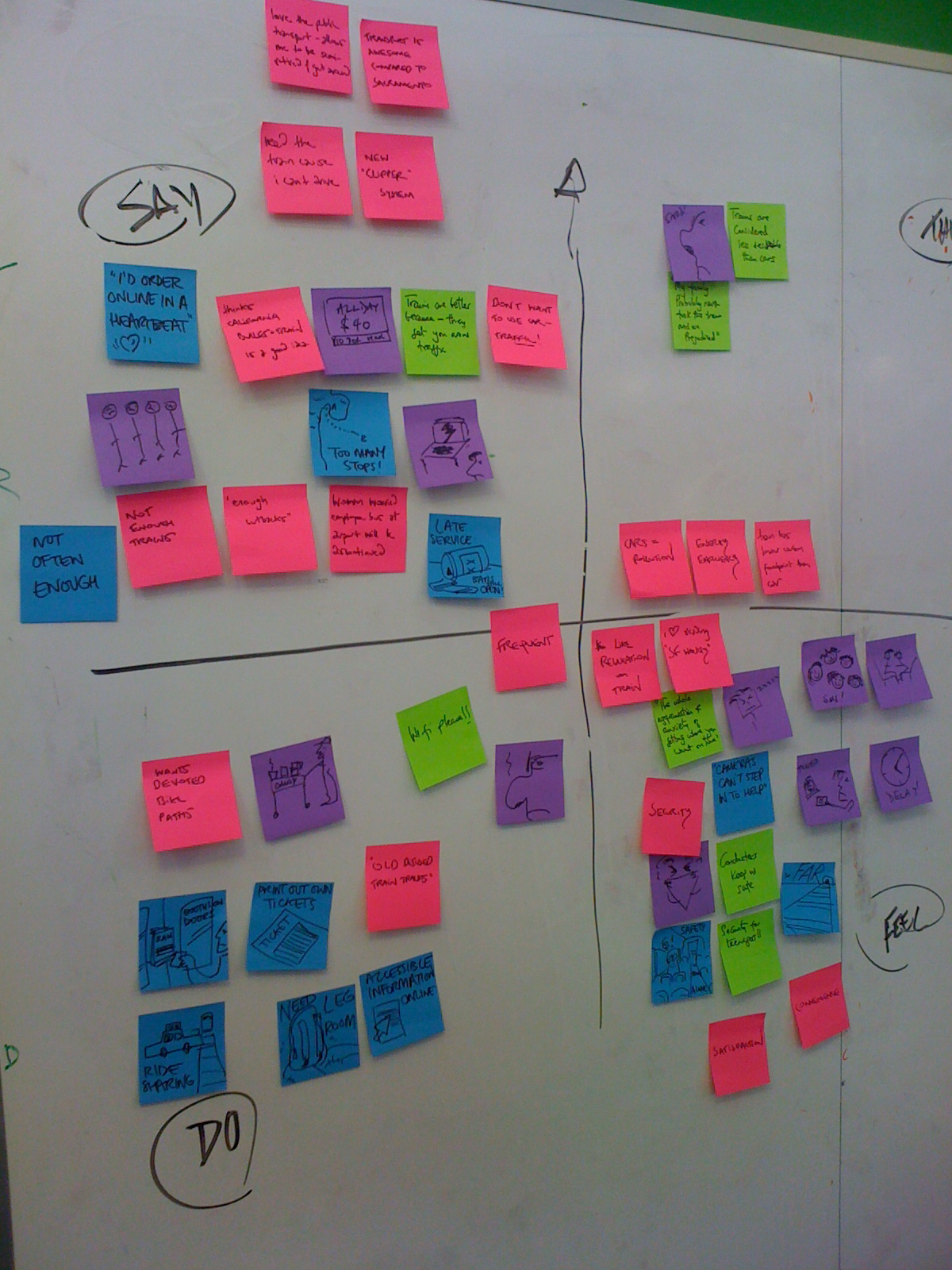
a whiteboarded rainbow of inspiration
For an update on my ever-evolving Knight Project on an online multimedia comics interface, you’ll be wanting the Knight Project page.
Today was the first half of the Knight’s crash-course at the Stanford D.School in design thinking, half of which took place on the Cal Train and involved tackling the challenge of commuting: how to improve the overall experience, how that varied for the different types of commuter, the emotional influencers that dictate commuters’ behaviours etc. Once we’d acosted various travellers on the Bayshore-Palo Alto slow train and dodged the wrath of the design-challenged ticket inspector, we headed back to campus to thrash out our findings with post-its and whiteboards, dividing the feedback we’d received from interviews into 4 areas: things the passengers said, things they wish Cal train would do, things they felt towards their commuting experience, and things they thought. It was all about fast iterations, prototyping and not being hung up on getting a perfect result the first time round. In fact, being too eager to find an early solution stifles the creative process and will only limit your findings. Counter-intuitive, but very rewarding and looking forward to the follow-up session when we’ll dive deeper into designing a solution for our commuters tomorrow.
If you have any suggestions or feedback on ways to improve your commute, post a comment!

My haul from yesterday's Zinefest
I’m glad to say that the panel I was on at yesterday’s Zinefest provoked a predictably lively debate about the future of journalism and print publishing. Shockingly (to me, at least) only about 2 people in the audience had even heard of sites like Kickstarter or Chipin – not what I was expecting from the most creative, indie-minded spirits in the bay area.
To those of you unfamiliar with the fest, I’d say it’s like a more adult version of APE – same DIY/punk spirit, but fewer zombie comics and more socially conscious creators. Highlights from a few laps of the County Fair Building were: the Zines on Toast peeps from the UK, currently on a nationwide comics tour; Susie Cagle, fellow Bay Area comics journalist, whose comics on Food Not Bombs (9 Gallons, see left from my pile) and a recent trip to Israel were must buys; radical stalwarts AK Press, who hopefully will carry the Honduran coup comic (news on that when I have it); and Sparkplug books, who might do too. Rummaging around in various piles I also found some vintage Seth Tobocman (Squatter comics, see left), as well as a vegan cookery zine that looks interesting.
I’ve also been excitedly looking through the online Stanford Uni course catalog to choose my courses for the upcoming year – one of the many myriad perks of being a Knight Fellow. So far I’m leaning towards the Art and Communication depts, though there were a few neuroscience courses that took my fancy…One of the many innovative Stanford-related websites I came across was the Persuasive Tech Lab, which focuses on the interaction between decision-making and technology, and other behavioral connundrums. Currently they’re linking to this amazing audiovisual mashup of a song comprised of various different would-be youtube stars’ voices/tunes. Check it out below, it’s the future of creative collaboration (and music):
A bit more information on Monday’s big news about my Knight Fellowship: it’s essentially a year-long stint at Stanford university during which fellows are expected to develop a project thesis on a specific area of innovation within their journalistic field. Not to mention having full access to the gold mine of Stanford’s classes and resources, fellow Knights and students/faculty. My pitch, as you’ll see from the impressive line-up of project summaries, will involve the creation of a rich content digital comic, taking full advantage of the flexibility of the web’s infinite canvas along with its capacity to stream video, animation and include interactive elements. Once the fellowship begins in September I’ll start chronicling the development of the project as I tie its disparate elements together.
Speaking of innovation, one project that’s been slowly percolating over the last several months has been my work with Fulbright fellow Olga Trusova on raising awareness about human trafficking through digital/interactive comics, in conjunction with the International Organization of Migration (IOM). Olga’s been in the field since the end of last year, visiting NGOs in her native Ukraine and interviewing staff and victims who have dealt with the reality of trafficking first-hand. She then sends me her detailed notes which I translate into comics. We recently premiered the first comic at an NGO meeting in Kiev and are currently revising the artwork to incorporate the feedback, so I’ll post some finish panels sometime next week.
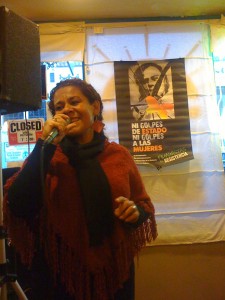
Karla Lara performing at Sunrise Cafe, SFO
Last week I made it down to the Sunrise Cafe in the mission to hear Honduran artist, performer and activist Karla Lara sing and report back on the situation in Honduras. It was a great chance to meet members of the resistance (local to SFO and Tegucigalpa), as well as promote the comic, which went down really well. I’ll be attending the Sunday May 16th meeting at the Berekely Fellowship of Unitarians to sell more comics and talk to delegates fresh from Honduras, so save the date if you’re in the bay area – more details to come. If this is the first you’ve heard of the Honduran comic, then click here to find out more.
 I’m back in Cali after an xmas jaunt to the UK, hence the lack of recent updates, and it’s all kicking off. I’ve just finished next month’s Bash piece on Nigerian beggars, and am putting to bed the latest issue of Archcomix, which contains all of my recent non-fictional work. The Chile strip will be picking back up now, so be sure to stay tuned. I’m aiming to get it all done and dusted by Jan 28th. Fingers crossed.
I’ve joined the Stanford Graphic Novel Project as a TA of some description, where I’ll be contributing my artistic insights into what will be the follow-up to the highly successful Shake Girl graphic novel they made during last year’s class. Today’s assignement was a crit of Nick Abadzis’s Laika, which blew me away. Fantastic storytelling, great characters, excellent use of colour – well, why don’t you just read my 2 cents below:
For a story that is so tightly paced and heavily research-driven, there is a great looseness to the style of the book. Abadzis’s use of two techniques – drybrushing (using a paintbrush caked with dried ink to create a jagged, scratchy line) and drawing with a china marker (again, leaving a crayon-like mark) are both clearly visible on the cover and lend a real hand-crafted, impressionistic feel to the book. Both of these rely on being combined with colour to bring them to life, and the first sequence of Korolev’s escape from the Gulag shows just how crucial colorist Hilary Sycamore’s contribution to the book was. One subtle effect is the use of colour in the page background (in between panels) to reflect the change in temperature and mood – from the bleak black desperation of the first shot of Korolev, which gradually lightens with the presence of moon, until changing to normal white when he arrives at the inn. In a nice parallel, characters or backgrounds are reversed to their black and white negatives in moments of extreme emotion – such as p.14 when Korolev comes close to death, or p.143 when Yelena is told about Laika’s tragic fate.
 Abadzis seems well aware of his own weaknesses, hence the scarcity of large panel close-ups on chracters’ faces – one such jarring example being the old lady’s face on p26. However, when he gives up on accurate representation and instead aims to convey raw emotion, the faces get really interesting – see Mikhail’s anger on p37 or his demagogic Dad’s on p.31. When he does go in for a close-up, Abadzis ramps up his use of blacks and the grease pencil, like p.14, 119, 137, although I think he’d have been better off preserving the consistency of his ‘less is more’ style for the sake of heightening the drama.
Certainly, page layouts carefully consider their setting – p11’s vertical panels to emphasize the starry sky and the expanse between Korolev and the moon; p82 horizontal format and rhythmic ‘to and fro’ contrast of Kudryavka and the technicians testing for G-force, and of course the dream sequences. But one original addition that crops up a few times is Adbadzis’s use of overlapping panels, which work as a full-stop/periods, overriding the authority of the page breaks to jump space/time: p.20’s change of scene from Antonina and Mishin’s chat to Korolev’s meeting with Krushchev; the p.38 jump from Mikhail being outside to his decision later that night to drown poor old Laika; or to show the time lapse in p.147 when Laika’s being operated on. He quickly builds up a visual vocabulary so that we know immediately that a circular, non-bordered panel is a window into Laika’s dream-state (p. 88).
I felt the book started strong, but lost some of its power in the build-up to the launch as it sacrificed its characters to the needs of the plot. The wordless episodes early on where the emphasis was on Kudryavka’s character as she experiences the world around her – foraging for food after surviving being dumped in the river, or experiencing zero gravity for the first time (p.91) – really stood out as we watched the dog’s personality come to the fore against a really rich, vivid background.
Above Panel from Laika by Nick Abadzis, courtesy of First Second Books
Here’s my latest addition to my portraits of Historical Greats – so far featuring Wilde and Joyce (who you can see in the Gallery section). It’s from a photo, not a scan, so pardon the poor image quality.