To Top
First, a test video for your viewing delectation and feedback: is the speed too fast? Is the text legible enough? Talk about your low-fi setups…
Below is a transcript of a recent email conversation I had with a fellow multimedia storyteller, Bo Soremsky, who put together this awesome interactive piece about a trial in his native Germany. Bo’s Qs are in bold.
People often ask me why i’m drawing pictures instead of taking photos. I’m sure you are familiar with that question. What’s your take on this?
People often forget that photos can be editorialized just as much as drawn images. Personally, I think a drawing is all the more sincere in explicitly revealing that the object depicted has been run through a subjective filter. All too often do readers forget that even a photographer has to crop in/out the elements they don’t want in a frame, and that’s before the editor has their say. Not to mention the possibility of it being tampered with in photoshop. To me, drawn images are the most accurate way of translating what’s in our heads onto paper – crystallizing our subjective experience. Provided a journalist is up front about that, I don’t see what the problem is, beyond the traditional aversion to what’s innovative versus something that’s been traditionally accepted. [Perfect example: Newsweek’s cropping of a Dick Cheney photo in 2009, prompting the longest comment thread ever on the NYTimes Lens blog – http://lens.blogs.nytimes.com/2009/09/17/essay-9/]
Without doubt drawings provide a very subjective view of the subject. So, how do you create authenticity? One answer to that question can be found in your hypercomic: By clicking on a panel the reader gets access to supporting documents. Thats a great way to prove your assertions. But are there other possibilities to convince the reader that you are telling the truth?
Sources are always going to be the key to authenticity, and linking is certainly one of the best ways around that. Incorporating more multimedia, housing multiple, corroborative views together could be another. I don’t think one single “truth” exists – even if you and I experienced the same event next to each other, we’d record and report it differently.
What do you think are the advantages of a digital reportage over a printed one? Does interactivity really help to tell good and authentic stories? Couldn’t it be to complicated and confusing?
I think interactivity is one of the few ways of demanding a reader’s engagement and involvement – readers/viewers get let off too easily these days in the era of clicking off youtube videos or channel surfing. Only by forcing the reader to drive the story can we be sure they are fully committed to the narrative – much like the way agency works in between comics panels to make sequential images seem like they’re part of the same story. It could well be complicated – the key is marrying a compelling story with an intuitive interface – no mean feat! (Not to mention being paid well enough to make it in the first place).
Wow. I know lately I’ve been prone to postponing my once-daily digital diatribes, but the sheer amount of work I’ve been getting through of late has tipped we way over the line. The main reason for that was the big push to the end of my Knight Fellowship at Stanford, which I’ll write more about in detail on my Knight project page. In the meantime, visit this link to watch my 3 min hyper-summary of comics journalism and what I’ve been working on at Stanford. Or click here to see how the rest of my incredibly talented cohort spent their year via the re-engineering journalism Knight Fellowship Garage.
As you read each one, think about your reaction to the information, your level of engagement, and the likelihood of you wanting to find out more about this incident. Obviously, the amount of information will provoke a higher level of reader interest, so focus more on what factors are helping you to connect with the story (hint: it’s all about the visuals, as if you didn’t know that from being on this site already). All give different angles on the same incident, which took place almost 3 years ago in Baghdad.
1. From Reuters: July 12 – Photographer Namir Noor-Eldeen and driver Saeed Chmagh, both of whom worked for Reuters news agency, are killed in eastern Baghdad during clashes between U.S. forces and militants.
2. From the New York Times: BAGHDAD, July 12 (2007) — Clashes in a southeastern neighborhood here between the American military and Shiite militias on Thursday left at least 16 people dead, including two Reuters journalists who had driven to the area to cover the turbulence, according to an official at the Interior Ministry.
“They had arrived, got out of the car and started taking pictures, and people gathered,” Mr. Sahib said. “It looked like the American helicopters were firing against any gathering in the area, because when I got out of my car and started taking pictures, people gathered and an American helicopter fired a few rounds, but they hit the houses nearby and we ran for cover.”
3. Reuters again:
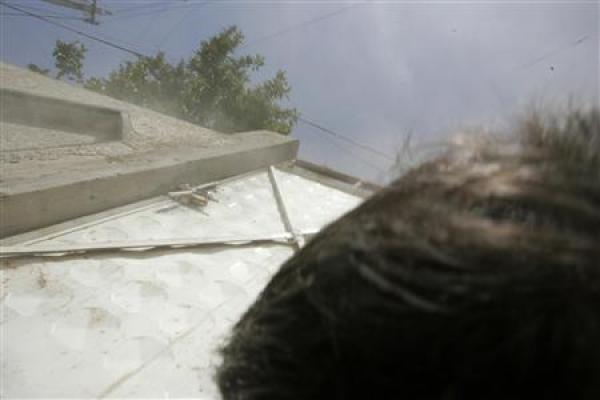
The last photo taken by Reuters photographer Namir Noor-Eldeen before he was killed on July 12, 2007
Photographer Namir Noor-Eldeen, 22, and driver Saeed Chmagh, 40, were killed in Baghdad on Thursday in what witnesses said was a U.S. helicopter attack and which police in a preliminary report called “random American bombardment”. The U.S. military in a statement issued just after midnight on Thursday described the incident as a firefight with insurgents. It has said the killings were being investigated.
“Our preliminary investigation raises real questions about whether there was fighting at the time the two men were killed,” said David Schlesinger, editor-in-chief of Reuters. Residents and witnesses interviewed by Reuters said they saw no gunmen in the immediate area where Noor-Eldeen and Chmagh were killed in Baghdad’s al-Amin al-Thaniyah neighborhood. They said they were not aware of any clashes in the area leading up to the Apache helicopter attack around 10.30 am local time. Noor-Eldeen and Chmagh had gone to the area after hearing of a U.S. air strike on a building around dawn that day.
On Sunday, the U.S. military returned to Reuters two digital cameras that belonged to Noor-Eldeen which were taken by American soldiers from the site of the deaths. No pictures taken by Noor-Eldeen on July 12 show clashes between militants and U.S. forces. The pictures show no gunmen, nor residents running for cover.
The U.S. military said last week it had called in “attack aviation reinforcement” after coming under fire from small arms and rocket-propelled grenades. Nine insurgents and two civilians “reported as employees for the Reuters news service” were killed, the statement said.
4. Video, courtesy of Wikileaks (visit their website for more information on their corporate/governmental whistle-blowing). Released earlier today at a press club meeting in Washington DC, the footage reportedly came through a source with connections to the military and has since been verified as legitimate and been broadcast globally (BBC, CNN, Al-Jazeera…) – here’s a full video report from Al-Jazeera (plus interview with the editor who published it online).
More on this tomorrow, but please post your comments/reactions – and retweet the link.