


To Top
What better way to kickstart this week than with a caricature of Jean Baudrillard spliced onto Tinkerbell’s body from a recent commission?  Click here to view Jean in all his transvestite glory. Here’s a snippet from his Simulacra and Simulation (come on people, even The Matrix directors co-opted it) to explain Jean’s link to Disneyland:
The objective profile of the United States, then, may be traced throughout Disneyland, even down to the morphology of individuals and the crowd. All its values are exalted here, in miniature and comic-strip form. Embalmed and pacified. Whence the possibility of an ideological analysis of Disneyland: digest of the American way of life, panegyric to American values, idealized transposition of a contradictory reality. To be sure. But this conceals something else, and that “ideological” blanket exactly serves to cover over a third-order simulation: Disneyland is there to conceal the fact that it is the “real” country, all of “real” America, which is Disneyland (just as prisons are there to conceal the fact that it is the social in its entirety, in its banal omnipresence, which is carceral). Disneyland is presented as imaginary in order to make us believe that the rest is real, when in fact all of Los Angeles and the America surrounding it are no longer real, but of the order of the hyperreal and of simulation. It is no longer a question of a false representation of reality (ideology), but of concealing the fact that the real is no longer real, and thus of saving the reality principle.
Turns out Mickey’s a demagogue. For an arguably harsher treatment of Walt’s shrangi-la, checkout Luis Marin’s “Utopic Degeneration: Disneyland”. One of the many interesting points Baudrillard covers (hold tight for a seamless link) is the different phases of the image: 1 It is the reflection of a basic reality; 2 It masks and perverts a basic reality; 3 It masks the absence of a basic reality; 4 It bears no relation to any reality whatever: it is its own pure simulacrum.
Recently I’ve been looking into the power of the photo as a conduit to “the truth” after being recommended Errol Morris’ blog at the New York Times (from where the series of below images is taken: Graphic by Dan Mooney for Errol Morris/ Photographs by Ben Curtis/ Associated Press). One question that always comes up in comics journalism is “aren’t you recreating what you imagine a particular scene to be?”, as opposed to photojournalists, who are presumably documenting what’s in front of their lens. Short answer? No. As the below images attest (aside from today’s sporadic fascination with all things Disney), the significance and ‘truth’ of an image is dependent on it context. Just like panels in a longer sequential narrative, the visual data in a photo can easily be subjected to myriad interpretations, depending on the information that it’s couched in. As Ben Curtis, the photographer from below, says: The caption is the thing that provides accurate context. And without an accurate context or with a misleading context, you can completely distort the meaning of an image.
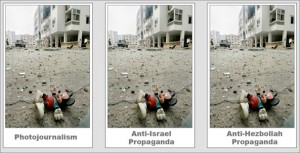 Another interesting point Morris makes in a different post, “photography as a weapon“, when a neuroscientist reveals that approximately 30 to 50% of our brain is dedicated to visual processing. When text accompanies an image, however, the linguistic interpretation occurs in a different part of our brains, prompting a cognitive emphasis on the image over the text, even if the text is clearly telling us not to trust the image.
In the words of Dr Hany Farid from Dartmouth: “It raises a whole other level of information warfare…You intentionally put things out there just to know that the controversy in and off itself will help you make your point.”



Submit a Comment