To Top
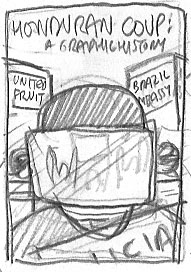 Thank you to those of you who voted for the cover design this week. After tallying up the combined interactive might of facebook comments, comments on my website (always looking for more, polls aside) and the poll I posted a link to, we have a clear winner. Number 3!
Justifying reasons included: it jumps out at you; it’s got more visual impact; it puts you directly in the scene; it’s more dynamic than the other designs. I have to confess, I was all for the first design (sort of a cast of characters lined up), until the votes made me reconsider just how effective (as opposed to informative) it was. So I’m proud to announce that no.3 has already been on my drawing board and is primed for the scanner – the full colour version should be up on Friday, so be sure to check back in and leave your comments then.
Speaking of impacting visuals, I recently came across the amazing talents of Kseniya Simonova, the winner of (dare I say it) Ukraine’s got talent. Her talent? Creating a live animation (that’s in 8 minutes of real-time) about the devastation wrought in the Ukraine during World War 2. Not the first time that the ‘…’s got talent’ franchise has brought millions to tears, but thankfully the first when they’ve actually been genuinely moved and -dare I say it – been intellectually engaged at the same time. But don’t take my word for it – here’s her in action in the final.
It’s an interesting trend that seems to have also caught on over at the Guardian UK, where Patrick Blower has created a niche column called ‘Live Draw’ that uses time-lapse photography coupled with screen capture to show readers how his editorial cartoons are created, line by line. Checkout his recent ‘Alice in Blunderland’ cartoon or the archive. Interesting how he’s referred to as a ‘cartoonist’ and a ‘multimedia artist’ – presumably ‘multimedia cartoonist’ is too much of a mouthful. Comparing the two, I think the real seductive power lies in the sequential narrative that’s being created – Blower includes single panel gags that he builds up over the course of a minute, but these aren’t anything as powerful or entertaining as his tableaux that incorporate different scenes and viewpoints, like this introductory animation on his website’s homepage. The challenge now is to incorporate more of a didactic element into these multimedia creations – to give new readers/members of the audience an introduction to the content or themes that appear in the work, or at least a way of following up if their interested is piqued.You’ll notice that only a handful of the comments in Blower’s Alice animation even acknowledge the piece’s status as a cartoon – it’s more soapboxing back and forth than anything, so obviously it’s appealing to an audience already familiar with the issue. I wonder how the approach could be altered to bring politics to life for someone whose not politically engaged. Suggestions? Stay tuned for my tentative experiments with a similar process in the future.
In case you missed it, voting is still open for your favourite cover design of the four that I posted on Friday – scroll down to view them, then leave a comment or vote using this here link.
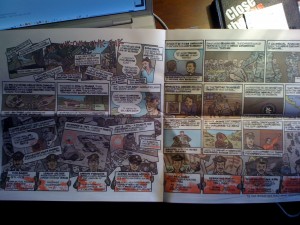
The School of the Americas comic is now in print as the full-colour centrefold (now then) of the latest issue of Presente!, the School of the Americas Watch newsletter. Here it is in all its tactile glory on my desk. Order your free copy and find out more about the SOAW here.
And in case you’ve had your head in the sand the last few days, or are an ardent global warming naysayer (not that there’s much of a difference, admittedly), spare a thought for the poor souls in Chile, who are reeling from one of the strongest earthquakes in recorded history that has destroyed 1.5 million homes and left 700 dead, with the toll expected to rise. It turns out that the strongest ever earthquake (a massive 9.5 on the Richter scale) also hit Chile, some 50 years ago, making it the go-to place for seismologists to conduct research. So thankfully, emergency procedures and containment plans for recovering from such a disaster were already in place and no doubt saved a large number of lives. More on this from the BBC here.
Naturally, comparisons have immediately been drawn between the devastation in Haiti and Chile. Despite Chile’s quake being 5 times stronger, the damage is considerably less than January’s quake, largely due not only to the fact that the epicentre of the Haitian quake was much closer to the surface, but also to the far more advanced construction of Chilean buildings (for reasons outlined above). Another point also worth bearing in mind is the rapid, efficient response of Chilean President Michele Bachelet to the disaster: she held off immediate foreign aid for fear of complications; ordered police to allow victims free access to essential supplies from supermarkets; and was soon offering minute-by-minute updates on the recovery efforts. A far cry from the debacle in Haiti, where international efforts were complicated by the US unilateral takeover of the main airport and subsequent diversion of non-US approved flights, plus the worrying number of US troops (reportedly around 10,000) who were deployed ‘for security purposes’. Surely emergency disaster relief is the UN’s chief role? So it would seem on their website.
Saddest of all is the ‘satire’ of Pat Robertson’s now legendary diatribe against Haiti, which some eager blogger cut and pasted to fit the latest Chilean disaster. Sadder still is that so many in the blogosphere fell for it (here’s the full summary), taking it as a real report. Staying with Chile, below is a comic from the archive that I put together about the US involvement in the 1973 Chilean coup that ousted Salvador Allende. My thoughts, condolences and best wishes go out to those affected in Chile.
[GALLERY=2]
 Yesterday I was lucky enough to spend the day with visiting graphic novelist Nick Abadzis, creator of the Eisner award-winning Laika. He visited the Stanford Graphic Novel class on Weds, offering some great advice on our atomic bomb story and how to get your work seen by publishers. Later that night he then gave a fascinating talk on his research process and the steps he took from the original idea behind Laika all the way through to finished artwork – including a visit to Moscow to get a feel for his backdrop. Yesterday he, Adam Johnson and I went down to Cal Poly in San Luis Obispo, where Nick offered similar wisdom to the students there, as well as signing the odd dozen copies, each with a meticulously crafted (not to mention lightning fast) dedicated illustration. Here’s the man at work – note the blurred brushpen. A true cartooning gent and top dog (groan). Thanks Nick!
And now, the chance for you to get involved in the creative process of Honduran Coup comic. Below are 4 potential designs for the cover. Have a look at the four different options below and then register your vote for the favourite one using the poll I’ve created here. I’ll announce the results next week. This is a first-time experiment for me, so depending on how many votes come in I’ll expand more interactivity into this site in the coming months. Anyway, back to the voting options:
Number 1 Number 2
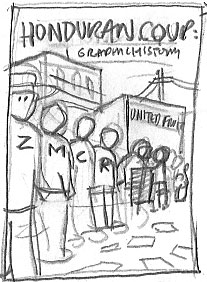
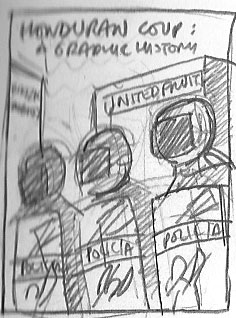
Number 3 Number 4

I’m leaning towards number 1 at the moment, which features Zelaya (Z), Micheletti (M), Clinton (C), Romero (R), riot police and Zelaya supporters in a line, outside the Brazilian Embassy and United Fruit factory (for its historical connection to US interests in Central America). Cover 2 features a line of said riot police, no.3 focuses on the reflection of supporters in the protective visor of a riot police officer (my second choice) and no.4 is more of a boxing showdown-style setup with Zelaya facing off with Micheletti, leaving the rest of the ensemble cast in the background.
Panel 1: Seen here with the report is IACHR President, Luz Patricia Mejia Guerrero. Here’s the full report.
Panel 5: News of this predictable yet disturbing development here.
Panel 6: Depicted here is Jorge Rivera Aviles, Chief Justice of the Honduran Supreme Court. For more on his decision, click here.
Panels 1-3: Supporting evidence again thanks to Joe Shansky’s article, Killing Activists in Honduras, published in Upside Down World and on his website.
If you can’t wait to read the rest of this final installment of the Honduran Coup, the complete third part is now up online at the Huffington Post. Please leave a comment or RT the link.
In the meantime, become an Archcomix fan or pre-order your Honduran coup comic for $5 plus shipping if you haven’t already – pre-orders close in the next 5 hours.
Panels 1-4: Supporting evidence again thanks to Joe Shansky’s article, Killing Activists in Honduras, published in Upside Down World and on his website.
The big news you’ve all been waiting for – the whole final installment of the Honduran Coup is now up online at the Huffington Post. Please leave a comment or RT the link.
In the meantime, become an Archcomix fan or pre-order your Honduran coup comic for $5 plus shipping if you haven’t already.
Panels 1-4: The COFADEH report can be viewed here.
I also have some big news that you can play a part in. I’ll post it on Monday, so be sure to come back and see how you can get involved.
And if you haven’t already…
Become an Archcomix fan or order a copy of the Honduran coup comic – less than a week left for pre-orders.
Panel 1: Direct quote from Hillary Clinton on the State dept website.
Panel 2: Read the COFADEH report here.
And if you haven’t already…
Become an Archcomix fan or order a copy of the Honduran coup comic – less than a week left for pre-orders.
I don’t think I was alone in finding Barack Obama’s nuclear change of heart a little odd, and more than a little hypocritical. Let’s skip back to December, and his Nobel Peace Prize address. Which, incidentally, made him one of the few prize winners to argue for war in his acceptance speech: “To say that force is sometimes necessary is not a call to cynicism – it is a recognition of history; the imperfections of man and the limits of reason”. When it comes to waging war, reason will apparently only take you so far. Presumably after that it’s intuition, or maybe divine inspiration – we need only look back to the former President for that, courtesy of the Independent UK.
But I digress. The important thing here is Obama’s policy towards nuclear weapons, which incidentally was the reason he was awarded the Nobel in the first place. Here he is again: “One urgent example is the effort to prevent the spread of nuclear weapons, and to seek a world without them. I am committed to upholding this treaty. And I am working with President Medvedev to reduce America and Russia’s nuclear stockpiles.” That was December 2009. Hence the double-take when he announced in the latest budget that the agency responsible for the US’ nuclear weapons stockpile would receive a 13.4% increase from the previous fiscal year, totalling $11.2 billion. Granted, some of that would go towards controlling and securing existing nuclear warheads, but then there’s also “plans to go to full production of the refurbished Navy W-76 Trident submarine warhead, to refurbish the B-61 bomb, and to study options for maintaining the W-78, the warhead in the Minuteman III intercontinental ballistic missile.”
Coincidentally, in the same month that this nuclear leap was taken, one of the lone survivors of both of the 1945 atomic bombings in Hiroshima and Nagasaki, Tsutomo Yamaguchi, died aged 93. Amazingly, he was within the designated ground zero area (3km from the blast) for both. The students of the Stanford Graphic Novel Project have chosen his incredible testimony as the basis for their graphic novel, and the first few pages were excitedly written on Monday. To get a sense of the unbelievably apocalyptic level of destruction in Hiroshima and Nagasaki when the bombs dropped, check out this recent NPR podcast with the author of Last Train from Hiroshima, a collection of survivor testimonies.
In other news, the Independent World Report is running my Diego Garcia comic in their latest issue, but you can check it out here. And there’s only a week to get your pre-orders for the Honduran coup comic in! See the widget to the right and spread the word.
Panel 2: For disputes on the legality of the coup and Zelaya’s supposed infraction of the Honduran Constitution, see the first part of the graphic history as well as the legal evidence here.
Panel 3: Go here for a list of such principles outlined by the Inter-Parliamentary Union in Geneva.
You can still pre-order your own 32p hard copy comic of the Honduran Coup here – $5 plus shipping (US – $2, rest of the world $4)