To Top
Was what Nikil and I were treated to on Friday night, at Studio 40 in the mission. Both Eric Drooker and Seth Tobocman are comics art activists who have been in the game for more than a few decades now. Drooker has a long history of doing beautiful painted covers for the New Yorker (“undermining the mainstream”, as he calls it) while Tobocman is a self-professed radical who wears his politics very much on his sleeve.
Here’s a clip to give you a sense of what his performance was like.
Tobocman is also one of the founders of the political comics anthology World War 3 Illustrated, which will hopefully be running one of my pieces in their next issue.
His latest book, Understanding the Crash, uses his aggressive stenciling and arresting visuals to explain the economic flatline the US economy is currently straining to recover from and the roots of the housing crisis, which Seth puts down to the prevalence of “flipping”. That is, people mortgaging their first home in order to buy a second home so they can sell it quickly for a profit. Drooker showed us his photos from a recent trip to Gaza, where he joined local communities in painting on the towering Israeli security wall that looms over their homes. With an electric banjo accompaniment, he also showed us wordless panels from his latest collaboration with the folks at City Lights on an illustrated version of Ginsberg’s Howl, as well as his latest wordless graphic novel, Blood Song.
For more, voila: Eric Drooker and Seth Tobocman‘s websites.
As promised, the story continues. Hit “previous” for the start of the story, or stick “Borderland” in the Apture search bar at the top of the page for the full lowdown on the project, new page to be updated soon.
Russian lettering to be inserted into the roadside sign in the the first panel. Also, check out a over at the Comics Journal.
Hot off the drawing board, here’s a new piece from the upcoming Borderland comic I’ve been working on over the past year, turning the real-life testimonies of human trafficking victims from the Ukraine in partnership with Fulbright Fellow Olga Trusova. Comments, as always, very welcome. Especially on the spot colour.
More panels to come, as well as a good review and exciting update on the Honduran Coup comic. More regular updates will start back up again now that I’m nearing the summit of the mountain of pages needed to complete Borderland.
For those of you who aren’t familiar with the back story to the coup in Honduras that happened a year ago today, here’s a short and sweet video synopsis for you. The music is “Innocence” by “Working for a Nuclear Free City” off their “Businessmen and Ghosts” album.
Please digg/tweet/FB/fwd the link on and here’s to the ongoing struggle for justice that rages on in the face of continued repression.
It’s nose to the grindstone time at Archcomix HQ (temporarily based out of Ithaca, NY for the next 2 weeks), as I’m fighting to reach my daily goal of 1.5 pages of Borderland (my human trafficking comic), inked and penciled. So far, so good – even managed to get some done in Detroit airport at 6 in the morning. Just finishing a story about a worker who was kept enslaved at a Polish bakery and about to move on to a construction worker who was treated like an animal in one of Moscow’s most prestigious patches of real estate.
On a more upbeat note, my Knight Fellowship for 2010 is now only a summer away, so I thought I’d shed a little more light on the program and give you a chance to see what previous fellows spent their year working on.
June is Torture Awareness Month, so at the very least you can check out this video from the National Religious Campaign Against Torture. (Yes, even if you’re a devout pagan). Here’s a good place to start if you’re new to the US’s private use and public condemnation of torture. As for the discrepancy over why the debate over torture continues to preclude taking any actual steps to end it, check out this article from Slate on Maher Arar, best summarised by this quote:
Each time an American court declines to address this issue because it’s novel, or complicated, or a matter best left to the elected branches, it reaffirms yet again that there is no precedent for doing justice in torture cases. By declining to find torture impermissible, they are helping to make it acceptable…Given that [torture is illegal], he wondered, why was the majority of the panel searching high and low for some diplomatic, national security, or supersecret policy reason to defer to the other two branches of government to set the parameters of U.S. torture policy. There is no U.S. torture policy. We don’t torture. So why are the courts leaving it to Congress to set its boundaries?
Which is all the more interesting in light of Ex-VP Dick Cheney’s comments from last year on Fox News, as reported by the NYTimes:
“I knew about the waterboarding, not specifically in any one particular case, but as a general policy that we had approved,” said Mr. Cheney, who noted that neither a gun nor a drill had actually been used on detainees. “The fact of the matter is the Justice Department reviewed all those allegations several years ago…
…The judgment was made then that there wasn’t anything that was improper or illegal”
You have to love that relative clause in the first sentence. Move over Jack Bauer, Fox has a new all-american hero re-writing its constitution.
Amidst the craziness of last week, I forgot to write up my part in an innovative new educational exercise created by social workers in Missouri. On Friday afternoon, Bay Area community leaders and organizers gathered at the Garden House Hotel in Palo Alto to be given an alias, as well as a background history. We were then ushered into one of the conference rooms to meet other members of our “family”: in my case, I was Pablo Perez, a 23-year old who had abruptly become head of the family when my divorced Dad was thrown in jail, leaving me to care for my two young teen sisters and their baby sister. The rules were as follows: we had to survive for 4 weeks (15mins of real-time each) below the poverty line, negotiating the kafka-esque labyrinth of social services, state benefits and pawn shops while ensuring that all household members were fed and the utilites weren’t shut off. The perimeter of the conference room was arranged with tables representing the different organizations we needed to visit: employment agency, bank, pawnshop, supermarket, utility company, daycare, police station – and to add an extra headache-inducing element, we could only move from table to table by surrendering a ‘transport pass’, which we had to buy when we ran out. This was to reflect the proportion of benefits that end up wasted on expensive local transport when people try to make their way out homeless shelters for real.
Here’s a video of the same poverty simulation being run in Pittsburgh to give you more of a sense of what it felt like to participate:
Needless to say, what started out as an interesting interactive exercise turned into a stressful, exhausting nightmare as we were deliberately kept waiting, hamstrung by misfiled paperwork and long queues everywhere we went. Some particular highlights included being robbed of a transport pass by none other than local council member Greg Scharff, or of $20 by a homeless outreach specialist. I might add that both were in character at the time, but the irony wasn’t lost on me. Here’s a full write-up of the afternoon by the local Palo Alto Daily, including a description of the above incidents:
Dan Archer, a social issues cartoonist from Mountain View, stood befuddled in the middle of the room after his character was robbed of his cash on the way to the grocery. It was the same money he had spent so long obtaining in the previous week that he was late picking up his child at day care.
All in all, it was an excellent way to raise awareness of a vital issue that applies to communities nationwide, far more powerful and resonating than a lecture or article, and further proof that interactivity is a key trigger for engaging with an audience on what some might deem “dry” topics. For more information, visit visit Step Up Silicon Valley’s website at www.catholiccharitiesscc.org/stepupsv/ or the Downtown Streets Team’s website at www.streetsteam.com.
Last but not least, here’s the full video of comics journalist Joe Sacco‘s acceptance speech of his highly deserved Ridenhour Prize for Investigative Journalism. Interesting to see the stigma against the term “graphic novel” in his closing comments, as opposed to “comic book”, which he prefers. Surely it’s a formal question of length (comic books being serialised 28pp saddle stiched), while a graphic novels are self-contained, 80pp+ works? As ever, your comments are welcome below.
What better way to kickstart this week than with a caricature of Jean Baudrillard spliced onto Tinkerbell’s body from a recent commission?  Click here to view Jean in all his transvestite glory. Here’s a snippet from his Simulacra and Simulation (come on people, even The Matrix directors co-opted it) to explain Jean’s link to Disneyland:
The objective profile of the United States, then, may be traced throughout Disneyland, even down to the morphology of individuals and the crowd. All its values are exalted here, in miniature and comic-strip form. Embalmed and pacified. Whence the possibility of an ideological analysis of Disneyland: digest of the American way of life, panegyric to American values, idealized transposition of a contradictory reality. To be sure. But this conceals something else, and that “ideological” blanket exactly serves to cover over a third-order simulation: Disneyland is there to conceal the fact that it is the “real” country, all of “real” America, which is Disneyland (just as prisons are there to conceal the fact that it is the social in its entirety, in its banal omnipresence, which is carceral). Disneyland is presented as imaginary in order to make us believe that the rest is real, when in fact all of Los Angeles and the America surrounding it are no longer real, but of the order of the hyperreal and of simulation. It is no longer a question of a false representation of reality (ideology), but of concealing the fact that the real is no longer real, and thus of saving the reality principle.
Turns out Mickey’s a demagogue. For an arguably harsher treatment of Walt’s shrangi-la, checkout Luis Marin’s “Utopic Degeneration: Disneyland”. One of the many interesting points Baudrillard covers (hold tight for a seamless link) is the different phases of the image: 1 It is the reflection of a basic reality; 2 It masks and perverts a basic reality; 3 It masks the absence of a basic reality; 4 It bears no relation to any reality whatever: it is its own pure simulacrum.
Recently I’ve been looking into the power of the photo as a conduit to “the truth” after being recommended Errol Morris’ blog at the New York Times (from where the series of below images is taken: Graphic by Dan Mooney for Errol Morris/ Photographs by Ben Curtis/ Associated Press). One question that always comes up in comics journalism is “aren’t you recreating what you imagine a particular scene to be?”, as opposed to photojournalists, who are presumably documenting what’s in front of their lens. Short answer? No. As the below images attest (aside from today’s sporadic fascination with all things Disney), the significance and ‘truth’ of an image is dependent on it context. Just like panels in a longer sequential narrative, the visual data in a photo can easily be subjected to myriad interpretations, depending on the information that it’s couched in. As Ben Curtis, the photographer from below, says: The caption is the thing that provides accurate context. And without an accurate context or with a misleading context, you can completely distort the meaning of an image.
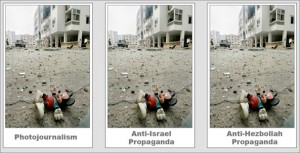 Another interesting point Morris makes in a different post, “photography as a weapon“, when a neuroscientist reveals that approximately 30 to 50% of our brain is dedicated to visual processing. When text accompanies an image, however, the linguistic interpretation occurs in a different part of our brains, prompting a cognitive emphasis on the image over the text, even if the text is clearly telling us not to trust the image.
In the words of Dr Hany Farid from Dartmouth: “It raises a whole other level of information warfare…You intentionally put things out there just to know that the controversy in and off itself will help you make your point.”
In case you missed it, voting is still open for your favourite cover design of the four that I posted on Friday – scroll down to view them, then leave a comment or vote using this here link.
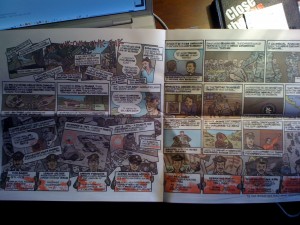
The School of the Americas comic is now in print as the full-colour centrefold (now then) of the latest issue of Presente!, the School of the Americas Watch newsletter. Here it is in all its tactile glory on my desk. Order your free copy and find out more about the SOAW here.
And in case you’ve had your head in the sand the last few days, or are an ardent global warming naysayer (not that there’s much of a difference, admittedly), spare a thought for the poor souls in Chile, who are reeling from one of the strongest earthquakes in recorded history that has destroyed 1.5 million homes and left 700 dead, with the toll expected to rise. It turns out that the strongest ever earthquake (a massive 9.5 on the Richter scale) also hit Chile, some 50 years ago, making it the go-to place for seismologists to conduct research. So thankfully, emergency procedures and containment plans for recovering from such a disaster were already in place and no doubt saved a large number of lives. More on this from the BBC here.
Naturally, comparisons have immediately been drawn between the devastation in Haiti and Chile. Despite Chile’s quake being 5 times stronger, the damage is considerably less than January’s quake, largely due not only to the fact that the epicentre of the Haitian quake was much closer to the surface, but also to the far more advanced construction of Chilean buildings (for reasons outlined above). Another point also worth bearing in mind is the rapid, efficient response of Chilean President Michele Bachelet to the disaster: she held off immediate foreign aid for fear of complications; ordered police to allow victims free access to essential supplies from supermarkets; and was soon offering minute-by-minute updates on the recovery efforts. A far cry from the debacle in Haiti, where international efforts were complicated by the US unilateral takeover of the main airport and subsequent diversion of non-US approved flights, plus the worrying number of US troops (reportedly around 10,000) who were deployed ‘for security purposes’. Surely emergency disaster relief is the UN’s chief role? So it would seem on their website.
Saddest of all is the ‘satire’ of Pat Robertson’s now legendary diatribe against Haiti, which some eager blogger cut and pasted to fit the latest Chilean disaster. Sadder still is that so many in the blogosphere fell for it (here’s the full summary), taking it as a real report. Staying with Chile, below is a comic from the archive that I put together about the US involvement in the 1973 Chilean coup that ousted Salvador Allende. My thoughts, condolences and best wishes go out to those affected in Chile.
[GALLERY=2]
News today that the US has decided to rename the Iraq war ‘Operation New Dawn’ to vaunt the US’s evolving relationship with the Government of Iraq. So it’s goodbye “Operation Iraqi Freedom”, hello new dawn. Despite the predictable media fanfare (drowning out the rising death toll, you say?), it seems no one actually did a google search before coining the moniker. Had they done, they’d have seen that amongst the top billings for ‘New Dawn’ is a rehab center for getting people back on the right track. The company’s slogan says it all: “Confidence. Security. Hope. Always” – sounds like a military press release to me. Speaking of which, here’s the original memo from the Dept of Defense suggesting the name change. Lest you commit the social faux pas of mismatching the wrong war to the wrong sobriquet, here are some personal favourites of mine:
“Operation Earnest Will” – no, it’s not the abortive first draft title of Good Will Hunting, it was the 1987-1988 Inter-State War in Iran
“Operation Deliberate Force” – best not to think about the need for the word ‘deliberate’ here – NATO Intervention in Bosnia 1994-1995
Both still sound better than “Operation WTF WMDs”, mind you.
This week’s book review corner features New Orleans: After the Deluge, an amazing piece of comics journalism that recreates the chaos and panic when Hurricane Katrina struck in 2005. It was originally serialised online, so you can actually read it here. The story focuses on half a dozen characters around the city and their contrasting reactions to the impending disaster. Based on actual testimonies, it’s a towering work that earns Josh Neufeld a place in the comics journalist hall of fame, next to Joe Sacco. Ok, so it’s still a small hall, but you get the idea.
Lastly, the more observant among you will have noticed the chipin widget on the right sidebar has been replaced by a new button, which will take you directly to the paypal checkout for a copy of the Honduran coup comic. Yours for $5 plus $2 shipping to the US, or $4 to the rest of the world. Not only that, but for those of you who are new to the site (welcome) or who haven’t ordered your hard copy of the Honduran Coup: A Graphic History (for shame), I’ve created this new page with all the information, links, quotes and background you could ever want, plus a radio interview thrown in for good measure.
Some amazing, bizarre and inspiring stories in the news this week. I came across the amazing one this afternoon, though it’s the form of the news that’s amazing as opposed to the content: the Winter Olympics’ use of a live twitter feed embedded in its online coverage so you can monitor trends in real-time as events unfold. See for yourself. Needless to say, the potential for this carried over into other news stories is massive.
The bizarre portion relates to the assassination guide mentioned in the title and is something straight out of the Bourne Identity franchise. If you hadn’t heard, Mossad, the Israel intelligence agency, is alleged to have carried out a covert operation to take out Mahmoud al-Mabhouh, a leading Hamas official, in his hotel room in Dubai on Jan 20. Aside from the furore surrounding the identities of the team involved (who are also alleged to have cloned British and Irish passports) and the undeniable fact that al-Mabhouh wound up dead, what is most unbelievable is the security camera footage that chronicles the entire operation, broadcast recently on the US’s ABC network. Click here for the play-by-play guide, should you ever need to brush up your black ops skills. A surefire contender for the least covert operation ever carried out.
Lastly, on the inspiration front, is news from Iran that dissidents are publishing a comic that chronicles life in Iran. I know what you’re thinking – you’ve already read Marjane Satrapi’s Persepolis. But whereas Satrapi’s incredible memoir relied on her childhood memories, this new project is being published in real time (there’s that buzzword again), and will be serialized three times a week. Click here for the full story or here for the start of the comic.