To Top
A request to new visitors to the site: (welcome!) on the right hand toolbar is a chipin widget that I’m using to get pre-orders for a hard copy, full-colour 32p comic about US intervention in central america – featuring both parts of the Honduran Coup: A Graphic History as published in Alternet and the Huffington Post. Read more about it on the chipin page I’ve created here.
For $5 (plus $2 shipping in the US and $4 overseas) you’ll get a copy of the comic as well as your name printed in the back, along with all the other donors to the project. We’re already well on the way (see the total) and payment is via paypal so totally safe. Be part of a group project to help raise awareness and produce an educational tool that will have a lasting impact.
At last the US has successfully brokered a deal between Zelaya and Micheletti. Hopefully this will also result in an investigation of the de facto regime’s litany of human rights abuses over the past four months, which are still continuing on the streets of Tegucigalpa. Articles about police ‘meowing’ and firing sonic blasts of pig noises at the Brazilian embassy in total impunity to keep the Zelaya party deprived of sleep sound both surreal and horrendous: here’s a great article by Joe Shansky at Pulsemedia.org on the worrying use of psychological weapons by police, both in the US and abroad.
Today’s comic is the first page of a new piece based on Diego Garcia, which many are labelling ‘the new Guantanamo’ for its role as one of the prime US Military bases for Iraq/Afghanistan, not to mention in interrogating ‘enemy combattants’. I’d entered it in the Observer Graphic Short Story Competition 2009, but perhaps as Joe Sacco was mysteriously taken off the judging panel in their final press release announcing the winners, it may have led to a bigger step away from any non-fictional entries. Who knows.
Although it’s been in the papers as a popular transit point for illegal rendition flights run by the CIA and MI6, my piece concentrates on the backstory to the island, more specifically how the UK and US governments conspired to illegally evict the island’s inhabitants from their home in the 1960s. Two invaluable sources were David Vine’s Island of Shame and John Pilger’s Stealing A Nation, which I thoroughly recommend. As always, the whole comic is posted on the COMIX page, so please forward the link around to raise awareness for the Chagossians’ campaign to return to their homeland.
Por fin – the spanish version of the Honduran Coup comic is now available on the COMIX page, and fingers crossed we’re one step closer to finding a home for it at an online Central American paper. Just been to an interesting talk about community building in Columbia as a way of tackling violence too, which may well trigger a Plan Columbia comic spotlight in the not too distant future. Thanks again for the continued interest in the comic – it’s now stocked at Columbia University (NYC)’s Latin American library and will be making its way to the eery-sounding Vault of Midnight comic store in Ann Arbor, MI.
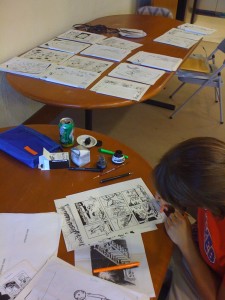
I can’t even remember the last time I posted so thank you my ever loyal web audience for hanging in there. I’ve just finished up teaching a 6-week comics course (2 classes a day, producing roughly 15 hand-drawn, inked and scanned 8-page minicomics every 10 days), the fruits of which (not to mention the labour) you can see below:
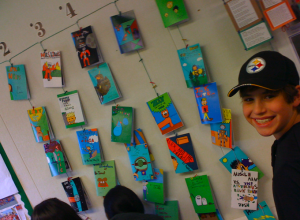

 Subject-wise, we had (deep breath): evil pillows; talking dogs; mice catching live cheese; toxic gloop; a shelter for made-up creatures called ‘hubs’; a talking cat bent on taking over the world; meteors; robot beauty pageants; musclemen (of course); talking pillows
(obviously a pillow trend going around 5-6th graders); time machines;
vampires; talking muffins; fratricidal ghosts; talking flying fish;
mysterious packages containing penguins; cute campers who have to
butcher a bear to survive out in the woods; twin weiner dogs; a halo
take-off; insurance clerks; talking toast; a water droplet and a
transvestite called Gerald. That’s all off the top of my head.
Whilst that’s been going on we’ve also -almost-managed to put to bed the Stanford Graphic Novel’s latest oeuvre. An amazing graphic novel set in one of the DR Congo’s National parks, it’s some 200 odd pages and is a testament to the drive, passion and commitment of everyone involved that it was first started back in January. Here’s a sneak preview of some of the revisions that are currently being frantically re-inked:
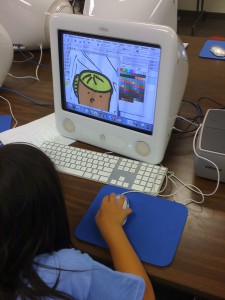
 Just when you thought I was going to take a break (or maybe that’s just my loving and tolerant wife), I’ve also turned my hand to animation, which is timely given the fact that as of tomorrow I’ll be teaching 3 weeks of Flash animation at San Jose’s tech museum. I’ll post my latest cartoon below, fingers crossed it works. Thanks to Queen for providing the soundtrack. I’ve also stuck some new watercolours up in the Gallery section for those of you interested in seeing my new colourful direction – quite how I can embrace that whilst not tripling how long it takes me to finish a page is, as yet, beyond me. Feel free to send in any suggestions.
Lastly, but by no means leastly, the hardhats piece continues to trundle along like the inky juggernaut it is – up to p.18 at the last count, though I’m reluctant to post any more pages up given the zany idea of actually making some money by having it published. News of that will be forthcoming, so stay tuned.
Here’s that cartoon I promised:
Follow this link to read several of my short story comics that have been published by Bash magazine over the last year – and compare the Chile piece with the Beggars story to see how much progress I’ve made. A big thanks to Jason Lutes for his invaluable crit advice.
Sadly Bash has had to shut up shop in the wake of print journalism generally dying, so pay your respects and visit the site today!
 I’m back in Cali after an xmas jaunt to the UK, hence the lack of recent updates, and it’s all kicking off. I’ve just finished next month’s Bash piece on Nigerian beggars, and am putting to bed the latest issue of Archcomix, which contains all of my recent non-fictional work. The Chile strip will be picking back up now, so be sure to stay tuned. I’m aiming to get it all done and dusted by Jan 28th. Fingers crossed.
I’ve joined the Stanford Graphic Novel Project as a TA of some description, where I’ll be contributing my artistic insights into what will be the follow-up to the highly successful Shake Girl graphic novel they made during last year’s class. Today’s assignement was a crit of Nick Abadzis’s Laika, which blew me away. Fantastic storytelling, great characters, excellent use of colour – well, why don’t you just read my 2 cents below:
For a story that is so tightly paced and heavily research-driven, there is a great looseness to the style of the book. Abadzis’s use of two techniques – drybrushing (using a paintbrush caked with dried ink to create a jagged, scratchy line) and drawing with a china marker (again, leaving a crayon-like mark) are both clearly visible on the cover and lend a real hand-crafted, impressionistic feel to the book. Both of these rely on being combined with colour to bring them to life, and the first sequence of Korolev’s escape from the Gulag shows just how crucial colorist Hilary Sycamore’s contribution to the book was. One subtle effect is the use of colour in the page background (in between panels) to reflect the change in temperature and mood – from the bleak black desperation of the first shot of Korolev, which gradually lightens with the presence of moon, until changing to normal white when he arrives at the inn. In a nice parallel, characters or backgrounds are reversed to their black and white negatives in moments of extreme emotion – such as p.14 when Korolev comes close to death, or p.143 when Yelena is told about Laika’s tragic fate.
 Abadzis seems well aware of his own weaknesses, hence the scarcity of large panel close-ups on chracters’ faces – one such jarring example being the old lady’s face on p26. However, when he gives up on accurate representation and instead aims to convey raw emotion, the faces get really interesting – see Mikhail’s anger on p37 or his demagogic Dad’s on p.31. When he does go in for a close-up, Abadzis ramps up his use of blacks and the grease pencil, like p.14, 119, 137, although I think he’d have been better off preserving the consistency of his ‘less is more’ style for the sake of heightening the drama.
Certainly, page layouts carefully consider their setting – p11’s vertical panels to emphasize the starry sky and the expanse between Korolev and the moon; p82 horizontal format and rhythmic ‘to and fro’ contrast of Kudryavka and the technicians testing for G-force, and of course the dream sequences. But one original addition that crops up a few times is Adbadzis’s use of overlapping panels, which work as a full-stop/periods, overriding the authority of the page breaks to jump space/time: p.20’s change of scene from Antonina and Mishin’s chat to Korolev’s meeting with Krushchev; the p.38 jump from Mikhail being outside to his decision later that night to drown poor old Laika; or to show the time lapse in p.147 when Laika’s being operated on. He quickly builds up a visual vocabulary so that we know immediately that a circular, non-bordered panel is a window into Laika’s dream-state (p. 88).
I felt the book started strong, but lost some of its power in the build-up to the launch as it sacrificed its characters to the needs of the plot. The wordless episodes early on where the emphasis was on Kudryavka’s character as she experiences the world around her – foraging for food after surviving being dumped in the river, or experiencing zero gravity for the first time (p.91) – really stood out as we watched the dog’s personality come to the fore against a really rich, vivid background.
Above Panel from Laika by Nick Abadzis, courtesy of First Second Books

What a week it’s been. I just got my hands on the comics anthology Paper TV, which was created by the class I taught earlier this semester at 826 Valencia, Dave Eggers’ Writing Center down in the Mission, and looks pretty damn awesome. I’ve also been interviewed in the December issue of The Other Side Magazine, so prepare to pounce on that next month all you Londoners. AND I’ve got a piece in the Spring edition of Memoir (and), which is a literary journal specializing in creative non-fiction. The piece is a colloboration I did with a friend of mine (nice one Olly) about gang violence in Nigeria. You can read it in the Comix section on this very site.
Last week was beyond hectic. A whirlwind tour of the East Coast, taking in Vermont, Greenwich and NYC, followed by a stint hosting the Center for Cartoon Studies‘ table at San Francisco’s Alternative Press Expo. Here’s a photo of me at the table looking as primed as you can be after a non-sleep redeye the night before.

As well as manning the table, along with CCS students and alumni (thanks Gabby, Kenny, Denis, Colleen, Emilie and Lauren!) I ran a colour workshop with Jenny Hansen, veteran color designer who has worked on shows like Happy Tree Friends and Batman: the animated series. Jenny waxed lyrical about using value, hue and varied palettes to creating and emphasizing mood in comics, and I was humbled to have her colour one of my panels as part of the live demo, which you can see here.

Last but not least, here’s a caricature of Karl Marx strutting about like Mick Jagger that I did for a friend’s housewarming last night. No nods to the President Obama being a socialist thankyouverymuch. Cheers for the party Nikil and Shannon!
 I’ve just finished designing this here flyer for the Center for Cartoon Studies Colo(u)r Workshop that’ll be featuring at San Francisco’s Alternative Press Expo this year on Nov 1st and 2nd. Bit of a departure from my usual style, and a stark contrast to the 9/11 strip above – second page will go up after this weekend.
If you’re a Bay Area local, pick up and treasure your very own flyer from one of San Fran’s fine comic-selling establishments as of tomorrow, when I’ll be dropping them off all over the city.