To Top
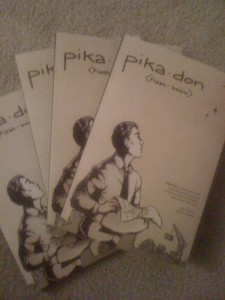 Pika-Don (“Flash-boom” in Japanese, the name given to the atomic bomb blast), the fruit of the SGNP’s labours over the past 6 months, is finally back from the printers!
Feedback so far has been overwhelmingly positive, so here’s to us finding a home for it at a publisher soon. For more info on the SGNP and its incredible 2010 students, check out this video.
It’s nose to the grindstone time at Archcomix HQ (temporarily based out of Ithaca, NY for the next 2 weeks), as I’m fighting to reach my daily goal of 1.5 pages of Borderland (my human trafficking comic), inked and penciled. So far, so good – even managed to get some done in Detroit airport at 6 in the morning. Just finishing a story about a worker who was kept enslaved at a Polish bakery and about to move on to a construction worker who was treated like an animal in one of Moscow’s most prestigious patches of real estate.
On a more upbeat note, my Knight Fellowship for 2010 is now only a summer away, so I thought I’d shed a little more light on the program and give you a chance to see what previous fellows spent their year working on.
June is Torture Awareness Month, so at the very least you can check out this video from the National Religious Campaign Against Torture. (Yes, even if you’re a devout pagan). Here’s a good place to start if you’re new to the US’s private use and public condemnation of torture. As for the discrepancy over why the debate over torture continues to preclude taking any actual steps to end it, check out this article from Slate on Maher Arar, best summarised by this quote:
Each time an American court declines to address this issue because it’s novel, or complicated, or a matter best left to the elected branches, it reaffirms yet again that there is no precedent for doing justice in torture cases. By declining to find torture impermissible, they are helping to make it acceptable…Given that [torture is illegal], he wondered, why was the majority of the panel searching high and low for some diplomatic, national security, or supersecret policy reason to defer to the other two branches of government to set the parameters of U.S. torture policy. There is no U.S. torture policy. We don’t torture. So why are the courts leaving it to Congress to set its boundaries?
Which is all the more interesting in light of Ex-VP Dick Cheney’s comments from last year on Fox News, as reported by the NYTimes:
“I knew about the waterboarding, not specifically in any one particular case, but as a general policy that we had approved,” said Mr. Cheney, who noted that neither a gun nor a drill had actually been used on detainees. “The fact of the matter is the Justice Department reviewed all those allegations several years ago…
…The judgment was made then that there wasn’t anything that was improper or illegal”
You have to love that relative clause in the first sentence. Move over Jack Bauer, Fox has a new all-american hero re-writing its constitution.
Panel 1: Order the book here More on its polemical background here.
Panel 2: More on Tony Judt, Noam Chomsky and Norman Finkelstein.
Panel 3: For more on the anti-semitic tract in this panel, go here.
Panel 4: Quote from RollCall, an online magazine.
Remember, there’s more Archcomix news below the fold.
Order your copy of the Honduran coup comic here.
Become a friend of Archcomix here.
I’m delighted to say that the International Organization for Migration, one of the world’s largest NGOs dealing with trafficking, is going to print 10,000 copies of my upcoming Borderland comic to distribute in and around Eastern Europe as part of an initiative to reach at-risk youth. This week, the whole “Pick of the crop” comic (featuring the panels above) – about a worker’s exposure to harmful pesticides while being forced to pick strawberries – is being handed out in Kyiv at an event for Ukranian youth: it’s on Saturday at Khreschatyk, 11 am till 3 pm, if you happen to be in the area.
On a different note, I recently came across these amazing online lectures from the RSA, which are a hybrid form of audio lecture and accompanying visual presentation, done with speeded-up time-lapse photography. The lecture itself is interesting in its own right – a defense of cartooning you might argue, given the focus on mastery (room for improvement), satisfaction (doing some good in the world) and being your own boss as the most important qualities of a job. See what you think and leave a comment!
[For some reason, you may need to hit the spacebar to start the video, instead of clicking on it]

My comic gets the group crit treatment for the first time in Kiev, Ukraine
One massive advantage for Olga and I as we’ve put together this comic on human trafficking has been the support of NGOs and student groups in the Ukraine. Knowing that you’ve been able to incorporate feedback from sources on the ground is critical not only to the credibility of a project, but also to dispelling any doubts that creep in about putting the world to rights from behind the cosseted safety of my drawing board, here in sunny California. The same was true of the Honduran comic, which included eyewitness reporting and drew on various different sources in Tegucigalpa. To give you a great example of this sort of collaboration, a few weeks ago, Olga presented the first draft of the story (3p) you see above to a group of students, professors and NGO workers in Kiev. They then workshopped the piece, bringing up concerns over the wording (always tricky given the tightrope between remaining faithful to a translation and not seeming too stilted), visual references (my original dumpster wasn’t right) and how effectively they thought it communicated the victim’s story. The second draft goes back to them next week, so fingers crossed they’ll be happy with the revisions.
I’ve steered away from commenting on news headlines of late to focus on what I’ve been working on, but one article about the recent furore around the ever-encroaching oil slick in the Gulf of Mexico caught my eye and is worth a mention. No, it’s not this priceless quote from BP CEO Tony Hayward:
“The Gulf of Mexico is a very big ocean. The amount of volume of oil and dispersant we are putting into it is tiny in relation to the total water volume”
More from the Huffington Post here, or the Guardian’s interview with Hayward here.
Current estimates put the total amount of oil leaked at 400,000 gallons (1.5m litres) – not quite up there with the 1989 Exxon Valdez spill at 40.9m litres, but with the potential to rival it, given the vast area the BP spill looks set to cover. Another thing the two spills have in common is the response from the company executives. Here’s Mark Boudreaux, a spokesman for Exxon Mobil, responding to claims that 18 years after the disaster, there are still 26,600 gallons of oil clogging up Prince William Sound:
“Based on our initial review of the report, there is nothing newsworthy or significant in the report that has not already been addressed. The existence of some small amounts of residual oil in Prince William Sound on about two-tenths of 1% of the shore of the sound is not a surprise, is not disputed and was fully anticipated.”
I’m not even going to go into the fact that Obama himself has weighed in on the “ridiculous spectacle” of oil executive finger pointing to chastise the companies’ refusal to accept any of the blame and pay for the cleanup, despite BP’s profits last year of $4.4 billion – an increase of 70 per cent on the same period in 2008.
No, what I’m interested in is BP’s elaborate attempts to cover up the magnitude of the spill from the media. Their measures include hiring local teams to ally with the coastguards and prevent journalists from getting access to the affected coastal areas (see left), as well as vetoing the taking or dissemination of aerial photography that would show the extent of the damage.
One man’s solution? DIY Aerial photography with nothing more than a makeshift rig, a balloon, and a cheap camera. Thanks to the Mediashift/Knight Projects Idea Lab for this excellent article. Visit grassrootsmapping.org for more info, and to get involved. Here’s the man behind the scheme (Jeffrey Warren)’s flickr page for more images.
Amidst the craziness of last week, I forgot to write up my part in an innovative new educational exercise created by social workers in Missouri. On Friday afternoon, Bay Area community leaders and organizers gathered at the Garden House Hotel in Palo Alto to be given an alias, as well as a background history. We were then ushered into one of the conference rooms to meet other members of our “family”: in my case, I was Pablo Perez, a 23-year old who had abruptly become head of the family when my divorced Dad was thrown in jail, leaving me to care for my two young teen sisters and their baby sister. The rules were as follows: we had to survive for 4 weeks (15mins of real-time each) below the poverty line, negotiating the kafka-esque labyrinth of social services, state benefits and pawn shops while ensuring that all household members were fed and the utilites weren’t shut off. The perimeter of the conference room was arranged with tables representing the different organizations we needed to visit: employment agency, bank, pawnshop, supermarket, utility company, daycare, police station – and to add an extra headache-inducing element, we could only move from table to table by surrendering a ‘transport pass’, which we had to buy when we ran out. This was to reflect the proportion of benefits that end up wasted on expensive local transport when people try to make their way out homeless shelters for real.
Here’s a video of the same poverty simulation being run in Pittsburgh to give you more of a sense of what it felt like to participate:
Needless to say, what started out as an interesting interactive exercise turned into a stressful, exhausting nightmare as we were deliberately kept waiting, hamstrung by misfiled paperwork and long queues everywhere we went. Some particular highlights included being robbed of a transport pass by none other than local council member Greg Scharff, or of $20 by a homeless outreach specialist. I might add that both were in character at the time, but the irony wasn’t lost on me. Here’s a full write-up of the afternoon by the local Palo Alto Daily, including a description of the above incidents:
Dan Archer, a social issues cartoonist from Mountain View, stood befuddled in the middle of the room after his character was robbed of his cash on the way to the grocery. It was the same money he had spent so long obtaining in the previous week that he was late picking up his child at day care.
All in all, it was an excellent way to raise awareness of a vital issue that applies to communities nationwide, far more powerful and resonating than a lecture or article, and further proof that interactivity is a key trigger for engaging with an audience on what some might deem “dry” topics. For more information, visit visit Step Up Silicon Valley’s website at www.catholiccharitiesscc.org/stepupsv/ or the Downtown Streets Team’s website at www.streetsteam.com.
Last but not least, here’s the full video of comics journalist Joe Sacco‘s acceptance speech of his highly deserved Ridenhour Prize for Investigative Journalism. Interesting to see the stigma against the term “graphic novel” in his closing comments, as opposed to “comic book”, which he prefers. Surely it’s a formal question of length (comic books being serialised 28pp saddle stiched), while a graphic novels are self-contained, 80pp+ works? As ever, your comments are welcome below.
At last a full reply (at the very bottom of this post) from Chris Bryant, the Minister responsible for the Overseas Territories on the subject of the Chagossians’ right to return. To read my comic on the issue, go here. Meanwhile, Chris Ware, the visionary comics artist behind Jimmy Corrigan: the Smartest Kid on Earth is in the news for his recent prank cover art for the new Fortune 500 list, which is surprisingly pointed for a graphic novelist who usually steers clear of politics: here are two highlights, including Guantanamo prisoners and an ‘exploitation 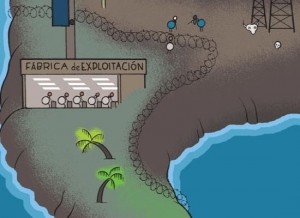
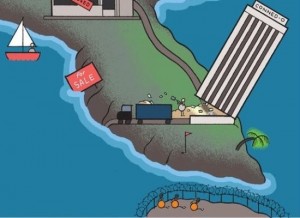 factory’. For the full story and the entire cover art, go here. As always, the piece has attracted its fair share of fans and critics, the latter of whom rails:
“My main objection is that this kind of smarmy, artsy-fartsy assertion of intellectual/political superiority only reaches the people who already know about and are convinced of corruption in the American economy. What’s the point if the people who need to make changes are only offended or don’t even “get it”? Mr. Ware would do better to donate half of what must be a lucrative income to charity, write letters, hold a sign up in front of a capitol building, and or spend his lunch hour serving in a soup kitchen.”
Interesting point, most deflated in my opinion by the flawed suggestions (let’s not even go into the ‘lucrative income’ part) for enacting grass-roots change, but it does beg the question: is laughter the goal of satire, even at the expense of informing a
viewer? It reminded me of a recent piece in the Guardian about the golden era of British TV satire, spearheaded by Spitting Image (see left for a quick intro to the show). Again though, this sort of entertainment could only appeal to those already familiar with the political hot topics of the day, and could arguably be said to only flatter the egos of the same people it sighted in its satirical crosshairs (see 4mins 10 secs). Can visual news media be informative/educational AND entertaining/humorous? Leave your comments/link suggestions below.
 .
.
Recientemente he visto más visitas desde algunos países hispanohablantes, en lo que imagino tiene que ver con mi cómic sobre el golpe de estado hondureño. Si este es el caso, quiere ir aquí
para la versión española. Y no se olvida ir a mi pagina de facebook, en donde puedes registrar como seguidor de Archcomix para poder ponerse al día con todo mis cómics nuevos.
For the rest of you, see above for the latest hardhats panels. Sneak preview of the now almost finished AIPAC comic coming up tomorrow.
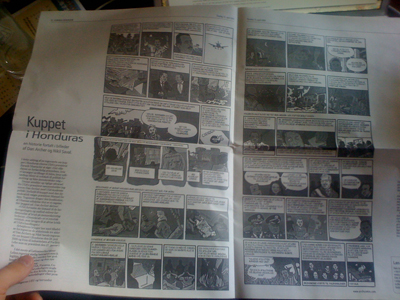
Centre-spread in last week's Arbejderen from Denmark
Almost all of the Honduran comic orders have now been shipped, so if you haven’t received your copy by the end of the month then get in touch. Unless of course you live in the UK/Europe, in which case you’ll just have to wait until that unpronounceable volcano in Iceland stops erupting. Also, please let me know what you think – I’d love to hear any comments you have. I’m currently working on an iphone app for my comics, and am mulling options for an ipad app too. In the meantime, checkout the lower-tech, hard copy of the Danish paper that ran the last part of the comic last week.
Click here to read a new page from Yiddishland over at the Social Histories page.
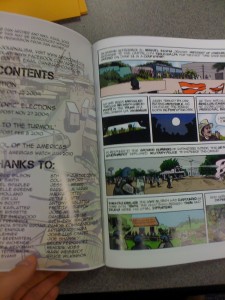 After what felt like an age of translating, tweaking, laying out, re-tweaking and all the rest in photoshop and indesign, I’m proud to announce that the first print run of the Honduran comic is underway as I type this. It should be ready in a few weeks time, so expect your copies around April 20th (US readers) and end of the month (rest of the world). I am now more aware than ever of the inevitable delays in going to print, but having seen one of the vast (almost full US letter size – see left with a stunt hand to give you a sense of proportion) copies in all its technicolour glory, I can tell you it’s well worth the wait. Thanks to Angela Vidergar for correcting my spanish translation for the second part. Now all I need are more orders to ensure I can push up the size of future print runs.
It’s always gratifying to see that it’s not just us self-publishers who are treading the precarious profit trail – apparently as of June, readers of the times in the UK will pay a princely £1 for the privilege of access to www.thetimes.co.uk for a day, or £2 for the working week. Here’s the full skinny, courtesy of that trusted bastion of fine journalism, The Sun. Surely it can’t mean a wholesale lockout/access denied scenario for the more parsimonious amongst us – it’ll probably be a bare bones version with none of the rich content that’s up there at the moment. Question is, will that prompt a split in news content between raw twitter-esque headlines and live feeds, embedded content and video/audio sources? Answers in the comments section. Speaking of which, the illustrious winner of the last post’s quiz on the most corrupt country in the world is…Somalia, closely followed by Afghanistan. The verdant wonderland that is New Zealand sneaked the least corrupt prize.
Perhaps the self-proclaimed “most revolutionary magazine in the world” holds some of the answers to the above question. Launched by Andy Warhol 40 years ago, Interview magazine’s ipad version seems remarkably unrevolutionary from the below video. In fact, the only stand out moments from the slideshow/larger iphone feel of the preview is the embedded live video. Until creators start to rethink the way they create content instead of simply publish it, all this digital innovation will seem like whistle-and-bells add-ons to the existing mode of information delivery. Decide for yourselves below: