To Top
Thank you to all who voted in the Borderland cover design poll: I’m pleased to say that my preferred design, number 8, won with 24% of the vote, closely followed in a dual tie by numbers 1 and 6 with 18%. The final cover artwork is about 90% finished now and I’m really happy with it, so be sure to check back in later on this week when I’ll post a low-res version for your comments. If you’re late to the poll or don’t know what I’m talking about, go here for the designs and here for an introduction to the project. It’ll have its own page soon.
I’ve been making more back-end changes to the site, adding comics here and there from the archcomix archive as well as adding various widgets: check out my flickr stream below on the right as well as new comics (AIPAC in its entirety on the US politics page) and reviews (perma-link to my recent Comics Journal review on the revamped “About” page).
Meeting Eric Drooker last week got me thinking back to my experiments with wordless comics, which peaked with the above piece for Bash magazine in Dec 2008. So much was being said about the then imminent financial crisis, I thought a wordless approach with all of its symbolic ambiguities was a novel way of pointing the metaphorical finger at the Credit Default Swapping troublemakers. Scroll down for lots of updates below the fold, and don’t forget to cast your cover design vote for my Borderland comic – voting closes in a few hours.
As I near the end of putting Borderland together (my human trafficking comic, for those of you new around here), I’ve been debating various different cover designs, some of which I’ve pencilled at full size only to find that they lack the impact (emotional or visual) I’m looking for. So in keeping with the Honduran coup comic, I’m throwing it open to you: peruse the options below and choose your favourite in the poll underneath. I’ll reveal the winner in a few days, as the cover is due by the middle of next week.

1. Half realistic portrait of one of the victims, the other half filled in with a map of Eastern Europe/Ukraine against a black background.

Cover 2: Similar to the Honduran Coup cover: reflections of imminent danger in the close-up eye of one of the victims

Cover 3: Understated. Assorted items presumably belonging to a victim - passport, identity papers, etc with "Borderland" rubber-stamped on top

Cover 4: Scattered ID papers belonging to the 7 different victims whose stories comprise the comic. A bit cluttered perhaps.

Cover 5: The victims walking towards us down a typical Ukraine high street with Kiev landmarks in the background. Subtle nods to the locations mentioned in the stories (nightclub signs, bakery etc).

Cover 6: The victims in the foreground, overshadowed by the different buildings that constitute their homes/work/prisons in the comic

cover 7: A beaten-up, weathered Ukrainian passport (in dark blue), which you open up to see the contents laid out like a passport (photo ID, DOB etc) Cons: Passport cover design alone not enough to grab a reader's attention.

cover 8: my favourite (no bias). The black is a Ukrainian passport, with assorted mocked-up papers/ID photo stapled over the top, as if we were the case worker for one of the victims.
From a collaboration with the late underground comics legend Harvey Pekar, who was found dead earlier today in his Cleveland home. Scroll down for a video of the man in action.
Harvey Pekar, the legendary underground comics writer and creator of the American Splendor series, was found dead at his Cleveland home earlier today. Pekar was an uncompromising champion of the American everyman, most famously in his tirades on the David Letterman show (see clip, left) and candid disregard for celebritydom and its trappings. I was lucky enough to collaborate with Harvey earlier this year on one of his final projects, a history of Yiddish literature and culture, which will be out in the Fall. Go to the social histories page for more extracts of Yiddishland, and RIP one of comics’ true greats.
Update: Above are sample panels from Yiddishland. As you may have guessed, the site is currently undergoing a redesign and I’m still ironing out some kinks, with the help of Stanford CS student Alex Easton. Thanks Alex!
Was what Nikil and I were treated to on Friday night, at Studio 40 in the mission. Both Eric Drooker and Seth Tobocman are comics art activists who have been in the game for more than a few decades now. Drooker has a long history of doing beautiful painted covers for the New Yorker (“undermining the mainstream”, as he calls it) while Tobocman is a self-professed radical who wears his politics very much on his sleeve.
Here’s a clip to give you a sense of what his performance was like.
Tobocman is also one of the founders of the political comics anthology World War 3 Illustrated, which will hopefully be running one of my pieces in their next issue.
His latest book, Understanding the Crash, uses his aggressive stenciling and arresting visuals to explain the economic flatline the US economy is currently straining to recover from and the roots of the housing crisis, which Seth puts down to the prevalence of “flipping”. That is, people mortgaging their first home in order to buy a second home so they can sell it quickly for a profit. Drooker showed us his photos from a recent trip to Gaza, where he joined local communities in painting on the towering Israeli security wall that looms over their homes. With an electric banjo accompaniment, he also showed us wordless panels from his latest collaboration with the folks at City Lights on an illustrated version of Ginsberg’s Howl, as well as his latest wordless graphic novel, Blood Song.
For more, voila: Eric Drooker and Seth Tobocman‘s websites.
More from my upcoming non-fiction project on human trafficking in Eastern Europe. Stick “Borderland” in the apture search bar at the top of the page for more info, or hit previous twice to go back to the start of the story.
As promised, the story continues. Hit “previous” for the start of the story, or stick “Borderland” in the Apture search bar at the top of the page for the full lowdown on the project, new page to be updated soon.
Russian lettering to be inserted into the roadside sign in the the first panel. Also, check out a over at the Comics Journal.
Hot off the drawing board, here’s a new piece from the upcoming Borderland comic I’ve been working on over the past year, turning the real-life testimonies of human trafficking victims from the Ukraine in partnership with Fulbright Fellow Olga Trusova. Comments, as always, very welcome. Especially on the spot colour.
More panels to come, as well as a good review and exciting update on the Honduran Coup comic. More regular updates will start back up again now that I’m nearing the summit of the mountain of pages needed to complete Borderland.
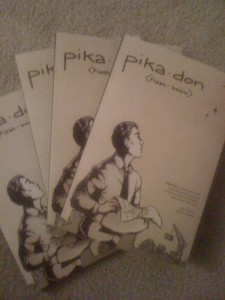 Pika-Don (“Flash-boom” in Japanese, the name given to the atomic bomb blast), the fruit of the SGNP’s labours over the past 6 months, is finally back from the printers!
Feedback so far has been overwhelmingly positive, so here’s to us finding a home for it at a publisher soon. For more info on the SGNP and its incredible 2010 students, check out this video.